
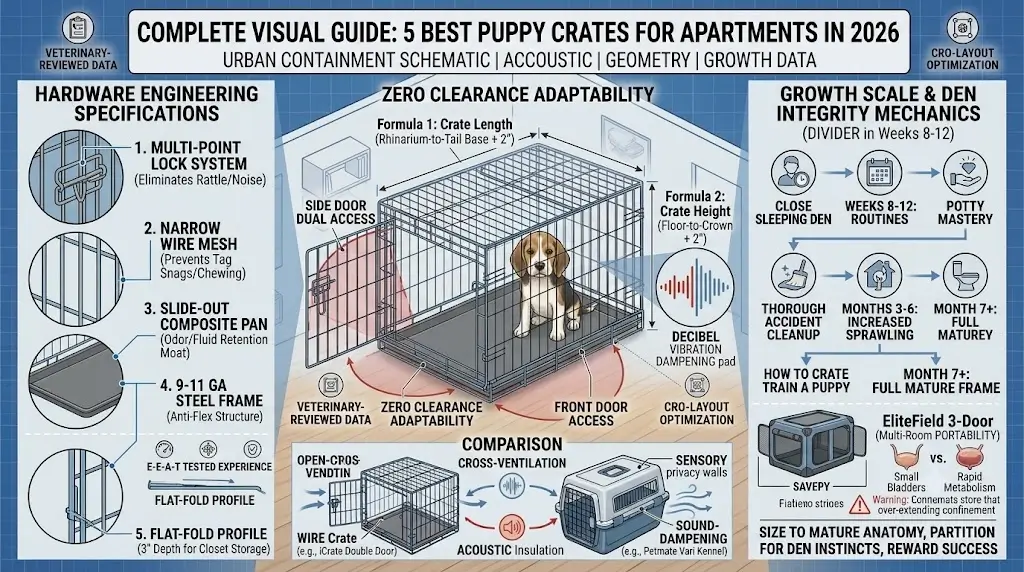
APARTMENT PUPPY CRATE BUYING GUIDE
Best Puppy Crates for Apartments in 2026: 5 Top Picks for Small Spaces
Selecting the best puppy crates for apartments requires balancing strict square-footage constraints with non-negotiable canine biomechanics. An urban apartment crate cannot simply be the smallest wire box crammed beside a sofa; it must provide uncompromised standing crown clearance, 360-degree turning radius, and full lateral recumbency, while solving micro-living hurdles like doorway swing clearance, acoustic rattle dampening, and rapid elevator potty routes.
For high-density residential living, our primary benchmark among the best puppy crates for apartments is a dual-door folding wire crate equipped with an adjustable divider panel and multi-point slide latches. Dual-access engineering eliminates room-flow dead zones by allowing side-entry placement flush against living room walls, while open-grid electro-coated steel maximizes passive airflow in climate-controlled spaces. For reactive urban puppies overwhelmed by hallway footsteps or elevator dings, rigid composite dens provide essential sensory insulation.
We benchmarked leading containment systems across specific urban architectural metrics—door radius clearance versus standard walkway widths, mechanical rattle noise under canine movement, pan-slide clearance without moving outer frames, and vertical fold profiles—to determine the best puppy crates for apartments available today.
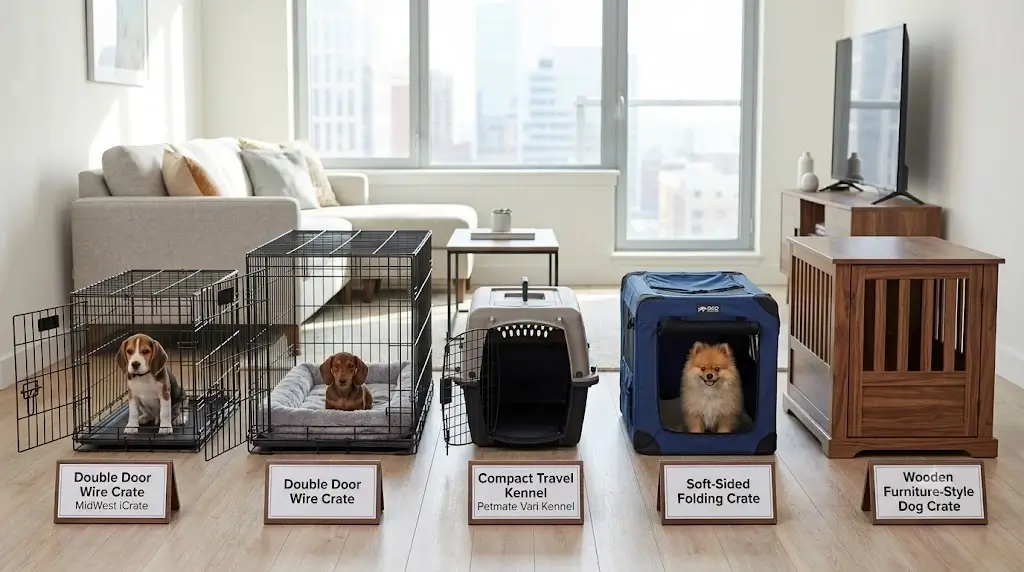
Comparison: The Best Puppy Crates for Apartments at a Glance
Apartment layouts demand flexible entry geometries, low acoustic resonance, and modular interior volume. The comparative matrix below outlines how the best puppy crates for apartments perform across critical small-space engineering parameters.
| Our Pick | Best For | Apartment Architecture Specs | Check Price |
|---|---|---|---|
| MidWest iCrate Double Door | Best Overall | Dual-door (front/side), 9–11 ga wire, 3″ flat-fold profile, divider | View on Amazon |
| Carlson Secure Double Door | Narrow Living Areas | Low-profile threshold, multi-point lock bars, side-access gate | View on Amazon |
| MidWest LifeStages Double Door | Growing Heavy Breeds | Reinforced 7–9 ga wire, heavy divider, torsional anti-flex frame | View on Amazon |
| Petmate Two-Door Top-Load | Acoustic Privacy & Travel | Polypropylene shell, top-entry door, sound-dampening walls | View on Amazon |
| EliteField 3-Door Soft Crate | Temporary / Multi-Room Use | 600D fabric, tubular steel frame, triple-entry, whisper-quiet | View on Amazon |
Small-Space Engineering Note: Front doors require an outward swing radius equal to the crate’s width (typically 18 to 30 inches), whereas side doors require clearance matching the length (up to 48 inches). Confirm clearance along high-traffic residential walkways before choosing the best puppy crates for apartments.
1. MidWest iCrate Double Door — Best Puppy Crate for Apartments Overall
Best for: Typical urban apartment setups, tight room corners, and first-time dog owners.
The MidWest iCrate Double Door ranks as the gold standard among the best puppy crates for apartments because its multi-access design resolves spatial bottlenecks without adding dead weight. In tight studio apartments or compact one-bedroom units, furniture positioning often eliminates front-door accessibility. By engineering an oversized lateral side door alongside the standard front door, this model can be pushed flush against walls, credenzas, or couches without obstructing puppy entry.
Manufactured with electro-coated 9-to-11-gauge steel wire, the iCrate Double Door provides 360-degree passive airflow, keeping puppies cool in apartments reliant on central HVAC. The slide-out ABS composite pan features a low-profile front pan stop, allowing you to slide the tray out for immediate accident cleanup without lifting or shifting the main crate frame across fragile hardwood or laminate floors.
The included steel divider panel ensures this unit stands out as one of the best puppy crates for apartments, allowing urban owners to invest once in an adult-proportioned crate while keeping the interior scaled to young puppy resting dimensions. To calculate the exact exterior footprint required for your dog, consult our detailed Puppy Crate Size Guide.
Why it stands out
- Dual-orientation entry: Side and front gates allow versatile room placement without blocking narrow walkways or baseboard heaters.
- Zero-lift sanitation: The ABS composite pan slides out beneath the locked perimeter door, keeping accident remediation isolated to the tray.
- Acoustic rattle dampening: Corner-locking clips reduce structural chatter when a puppy circles on the plastic pan during late-night hours.
- Rapid flat-folding profile: Collapses down to a 3-inch thickness with detachable carrying handles, storing easily under beds or inside closets.
Who should buy it
Apartment owners seeking the most versatile, ventilated, and cost-effective double-door wire crate that scales from an 8-week puppy to adult stature.
Who should choose something else
Puppies suffering severe separation distress who react aggressively to visual hallway movement, or high-drive working breeds prone to biting through lighter wire gauges.
Our verdict: The most practical, reliable, and adaptable containment enclosure for modern apartment living.
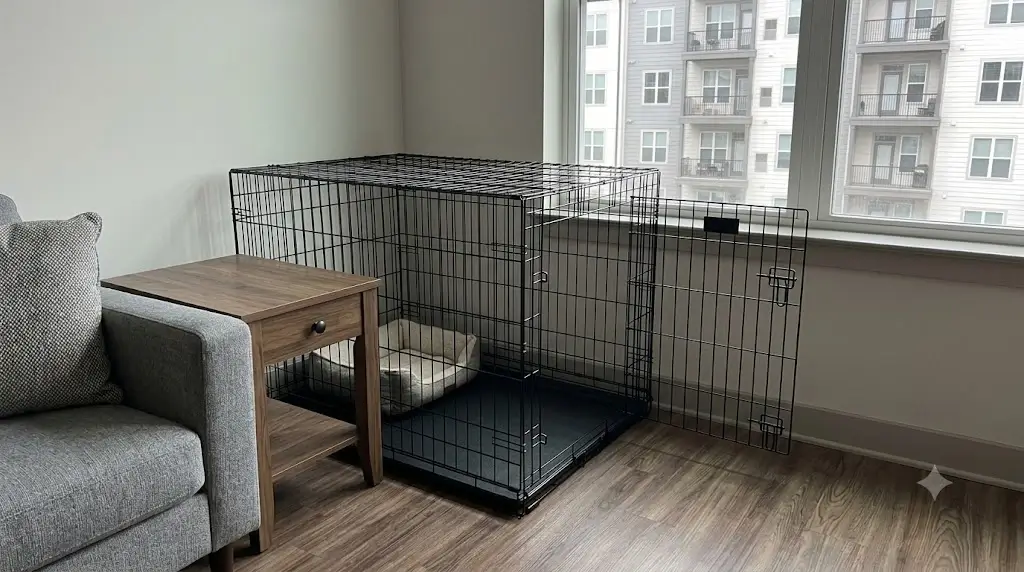
2. Carlson Secure Double Door — Best for Narrow Hallways & Tight Footprints
Best for: Studio apartments, narrow walkways, and puppies that lean heavily against doors.
When navigating tight residential dimensions, the Carlson Secure Double Door Metal Dog Crate stands out among the best puppy crates for apartments due to its low-profile entry thresholds and reinforced multi-point locking system. Standard wire latches can rattle excessively or experience frame flex when an energetic puppy paws at the gate, producing acoustic resonance that carries through shared apartment walls. Carlson counters this with heavy-duty slide bolts that anchor firmly into reinforced steel strike plates.
Constructed from all-metal steel with rounded perimeter edges, this crate protects delicate apartment baseboards and drywall from abrasive scratching. Its narrow-wire mesh grid prevents small paws from reaching outward to grab loose area rugs or electrical cords running along skirting boards.
The unit includes an adjustable partition panel that hooks firmly onto horizontal frame runners, preventing puppies from establishing a rear elimination zone. If your room requires a specialized partitioned layout, explore our comprehensive breakdown of the Best Puppy Crates With Dividers.
Why choose Carlson in an apartment?
- Multi-point lock security: Eliminates door rattling and frame flex, preventing acoustic disturbances in shared-wall buildings.
- Low-profile floor threshold: Prevents clumsy, uncoordinated puppies from catching footpads when exiting during fast potty dashes.
- Chew-proof metal build: Complete steel construction prevents teething damage to the crate frame or surrounding furniture.
Our verdict: An exceptional small-space problem-solver delivering quiet, rigid containment for apartments with zero square footage to spare.
3. MidWest LifeStages Double Door — Best for Growing Heavy Breeds in Apartments
Best for: Medium-to-large working breeds raised in apartments (Labs, Golden Retrievers, German Shepherds).
Raising a large-breed puppy in an apartment creates a unique equipment challenge: you need an enclosure built with heavy architectural steel that can withstand intense bite torque, yet you cannot afford multiple bulky kennels cluttering limited floor space. The MidWest LifeStages Double Door solves this dilemma, ranking among the best puppy crates for apartments by combining heavy 7-to-9-gauge wire construction with dual-entry functionality.
The heavier wire grid provides significant structural mass, preventing the crate from shifting or vibrating across wood flooring when a 40-pound adolescent puppy shifts position. Its heavy-duty divider panel locks rigidly into place, ensuring powerful puppies cannot displace the partition into the unoccupied rear quadrant.
To dampen metal-on-plastic vibration noise on shared apartment floors while preserving cranial clearance, pair your crate with low-profile bedding from our reviewed guide to the Best Puppy Crate Mats.
Why the reinforced build matters in apartments
The thicker wire framework eliminates frame warping under heavy load, ensuring latches drop cleanly into locking channels without sticking or binding during stressful potty-break transitions.
Shift the divider backward systematically based on physical skeletal markers—longitudinal spine length and standing shoulder height—rather than following an arbitrary calendar schedule.
Our verdict: The definitive choice for large-breed puppies in apartments where containment strength and placement flexibility are equally critical.
4. Petmate Two-Door Top-Load — Best for Acoustic Privacy & Anxious Barkers
Best for: Small-breed apartment puppies sensitive to hallway traffic, elevator chimes, and door slams.
Apartment complexes are acoustically demanding environments. For puppies that exhibit hyper-reactivity to corridor foot traffic or visual shadows under entry doors, open wire crates can trigger persistent alarm barking that strains neighbor relations. The Petmate Two-Door Top-Load Kennel counters this issue, proving to be one of the best puppy crates for apartments requiring acoustic and visual containment.
By eliminating 270 degrees of lateral visual stimulation, this enclosed plastic kennel creates an insulated sanctuary that lowers physiological arousal and encourages settled nap cycles. The continuous lower basin is completely seamless, guaranteeing that nighttime urine accidents cannot seep through to ruin rental apartment carpeting or hardwood floors.
The ergonomic steel wire top door is invaluable in small apartments: it allows you to lower a sleepy or resistant puppy inside from above without requiring expansive front clearance in narrow rooms.
Choose enclosed plastic when:
- Acoustic & visual dampening: Solid perimeter walls muffle shared-hallway noises and block visual triggers that cause barking.
- Vertical top-loading: Allows effortless placement in compact bedrooms where side or front door clearance is restricted.
- Guaranteed leak containment: Deep solid basin traps liquids entirely, protecting rental floors from subfloor staining.
Our verdict: The top-performing solution for noise-sensitive, reactive small dogs requiring visual privacy and dependable floor protection.
5. EliteField 3-Door — Best Soft-Sided Crate for Multi-Room Apartment Use
Best for: Crate-conditioned puppies, multi-room portability, and noise-free indoor resting.
The EliteField 3-Door Folding Soft Dog Crate delivers a lightweight alternative to metallic wire cages, making it one of the best puppy crates for apartments where an enclosure must be moved between living areas and home offices throughout the day. Built around an internal steel tube frame covered in 600-denier polyester with hexagonal mesh ventilation windows, it weighs a fraction of standard crates and produces zero mechanical rattle.
With doors on the top, front, and side, the EliteField integrates into virtually any room configuration. When folded, it packs flat into an included carrying bag, storing effortlessly behind sofas or in utility closets.
However, soft fabric crates offer minimal resistance against determined teething or separation distress. When considering the best puppy crates for apartments, use this model strictly as secondary portable containment for small dogs that have completed basic crate acclimation and stopped destructive chewing.
Best use cases
- Moving between home office and bedroom without dragging heavy metal frames.
- Zero mechanical noise when a puppy shifts positions during light sleep.
- Weekend travel or hotel visits where an ultra-compact storage footprint is essential.
Our verdict: Outstanding for noise-free multi-room flexibility, but unsafe for unsupervised, unconditioned teething puppies.
What Makes a Puppy Crate Good for an Apartment? Urban Engineering Factors
Selecting the best puppy crates for apartments requires evaluating spatial efficiency alongside canine developmental needs. The best puppy crates for apartments must satisfy five core criteria:
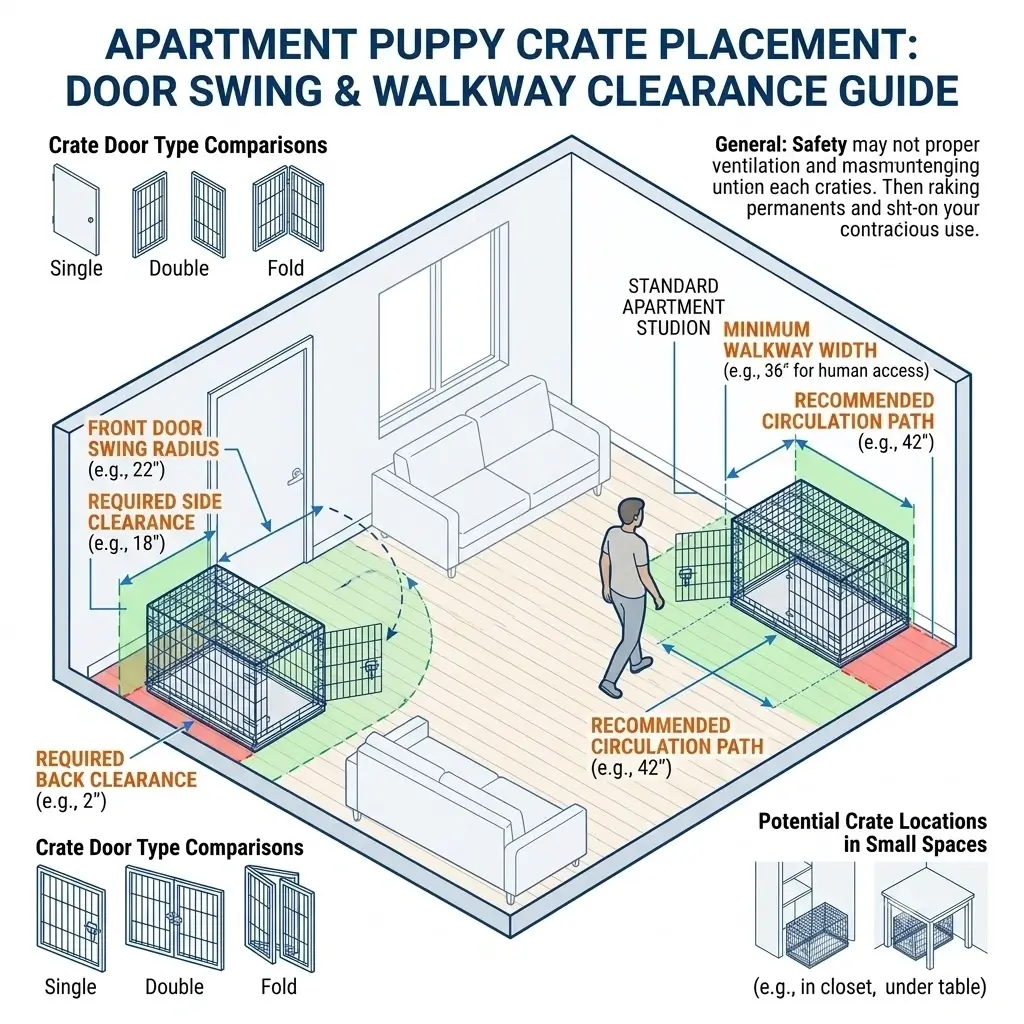
1. Multi-Door Placement Geometry
In compact apartments, a single front door forces the crate to project outward into walking corridors. Dual-door wire crates allow flush, lateral wall alignment, utilizing room length rather than width and preserving hallway clearance.
2. Acoustic Decibel Control
Shared apartment walls amplify metallic rattle. High-quality wire crates feature precision corner latches and snug tray retention channels that dampen vibration when a puppy stands or shifts, preventing noise complaints from neighbors.
3. Pan Extraction Clearances
Accidents happen during housebreaking. The best puppy crates for apartments feature front- or side-sliding pans with security latches, allowing you to extract, wash, and reinstall the composite tray without moving the entire crate framework.
4. HVAC & Microclimate Airflow
Apartments frequently experience stagnant indoor air pockets. Open-wire cages provide 360-degree passive cross-ventilation, preventing heat accumulation under heavy coats when radiant heating or air conditioning cycles on and off.
5. Modular Scalability (The Divider Factor)
Floor space is a premium resource in urban living. Rather than buying sequential small, medium, and large crates, investing once in an adult-sized enclosure with an adjustable divider maximizes budget and spatial efficiency.
How to Choose the Right Crate Size for an Apartment Puppy
Canine skeletal dimensions always dictate crate volume—not the square footage of your living room.
Artificially restricting crate volume to preserve apartment floor space causes severe musculoskeletal cramping, increases stress hormones, and triggers confinement-induced vocalization. Conversely, an oversized crate without a partition provides surplus floor space that encourages corner-soiling.
Follow these two non-negotiable anatomical formulas when sizing the best puppy crates for apartments:
Formula 1: Crate Length
Longitudinal Frame Length (Rhinarium to Tail Base) + 2 to 4 inches = Minimum Interior Length
*Note: Measure to the base of the tail only. Including tail length adds excess space, creating an elimination zone.
Formula 2: Crate Height
Standing Cranial Height (Floor to Crown or Pinna Tip) + 2 to 3 inches = Minimum Interior Height
If your puppy is an adolescent with substantial growth ahead, purchase the crate matching their projected adult dimensions and lock the included divider panel to satisfy these exact resting clearance formulas.
Where Should You Put a Puppy Crate in an Apartment?
Correct spatial placement is essential for successful crate conditioning when using the best puppy crates for apartments in high-density buildings:
Optimal Locations
- Living room corner: Keeps the puppy socially connected to daily family rhythms while providing a secure perimeter away from foot traffic.
- Master bedroom (early weeks): Placing the crate near your bed during the first 14 days reduces separation distress and allows you to detect nocturnal potty cues immediately.
- Adjacent to exterior entryways: Minimizes the transit distance across interior rugs during fast emergency potty transitions.
Locations to Avoid
- Directly adjacent to apartment entry doors: Footsteps, hallway conversations, and elevator bells trigger territorial alarm barking.
- Directly beneath HVAC vents or against radiators: Extreme temperature swings cause thermal distress and dehydration in puppies.
- Behind swinging interior doors: Risk of sudden frame impacts that cause confinement trauma and fear-based crate resistance.
The Apartment Potty Transit Challenge: Managing Elevators & Hallways
Potty training in a multi-story apartment building involves a distinct mechanical hurdle: the transit lag from crate door to outdoor grass. While suburban owners open a back door in 5 seconds, apartment dwellers must navigate corridors, elevators, and stairwells:
Apartment Potty Transit Protocol
Crate Door Unlatched → Immediate Physical Carry (Nose-Up Posture) → Elevator/Stair Transit → Outdoor Substrate Contact
Young puppies lack voluntary sphincter control when their feet touch textured surfaces after waking. Even when utilizing the best puppy crates for apartments, letting an 8-week-old puppy walk through apartment hallways will trigger an accident on corridor carpeting due to surface transitions. Always carry your puppy until their paws touch outdoor grass.
For an hour-by-hour operational breakdown coordinating crate rest, feeding times, and elevator potty runs, follow our structured Puppy House Training Schedule.
Wire vs. Plastic: Choosing the Best Puppy Crates for Apartments
| Operational Factor | Wire Enclosures (e.g., iCrate Double Door) | Plastic Shell Kennels (e.g., Petmate) |
|---|---|---|
| Door Orientation | Dual-door (front & side) maximizes small layouts | Single front door (or top-load) requires deep clearance |
| Acoustic Decibels | Higher metal vibration; requires floor pads | Lower acoustic resonance; deadens noise |
| Thermal Airflow | Unrestricted 360° cross-ventilation | Restricted; relies on window louvers |
| Spill Containment | Slide-out pan with 1-inch perimeter lip | Deep continuous molded leak-proof basin |
| Storage Footprint | Folds flat to 3-inch profile for closet storage | Bulky rigid halves; difficult to stash in small units |
For the vast majority of apartment homes, double-door wire models represent the best puppy crates for apartments, delivering the best balance of layout flexibility, ventilation, and growth management. Plastic kennels remain the specialized recommendation for sound-sensitive puppies prone to corridor-triggered barking.
How to Eliminate Puppy Crate Noise in Shared-Wall Buildings
Noise travels quickly through shared apartment floors and walls. Apply these four engineering adjustments to keep the best puppy crates for apartments whisper-quiet:
- Anchor high-density silicone floor pads: Place heavy silicone pads or an acoustic rubber mat beneath the crate feet to isolate vibrations from hardwood subfloors.
- Eliminate metal collar tags: Never allow dangling metal ID tags inside a wire crate; tag-on-wire clatter creates sharp noises that disturb sleep and pose strangulation risks.
- Dampen pan rattle with a low-profile mat: Lay a thin, non-slip rubber grip mat directly between the wire frame bottom and the plastic pan to silence plastic vibration.
- Address isolation anxiety proactively: Excessive whining is a behavioral symptom of rushed confinement, not an equipment failure. Never use the crate as punishment, and ensure biological exercise needs are fulfilled before closing the gate.
7 Dangerous Apartment Crate Mistakes to Avoid
1. Downsizing the Crate to Fit Available Floor Space
Purchasing an undersized crate to preserve apartment walkways restricts spinal extension and causes severe musculoskeletal distress.
2. Leaving an Adult Crate Unpartitioned
Allowing a young puppy unrestricted access to an adult-sized crate creates an indoor bathroom corner, ruining housebreaking habits.
3. Placing the Crate Against Shared Hallway Walls
Positioning the crate against walls adjacent to noisy common corridors subjects puppies to constant audio triggers, fueling alarm barking.
4. Trusting Soft Fabric Crates for Teething Puppies
Confining an unsupervised, teething puppy in a canvas crate results in shredded zippers, destroyed mesh, and life-threatening fabric ingestion risks.
5. Letting Puppies Walk Through Long Hallways
Walking an 8-week-old puppy down apartment corridors after waking guarantees accidents on hallway carpet. Carry them directly to the outdoor potty spot.
6. Forgetting Door Radius in Room Measurements
Failing to account for the outward door swing radius creates doorway traffic jams and scuffs expensive rental baseboards.
7. Exceeding Biological Bladder Limits
Confining an apartment puppy beyond their physiological holding limits forces den soiling:
Best Puppy Crates for Apartments FAQ
What is the overall best puppy crate for an apartment?
The MidWest iCrate Double Door ranks as the best overall choice among the best puppy crates for apartments. Its front and side entry gates solve placement challenges in tight layouts, while open-wire airflow, a slide-out composite pan, and an included divider make it exceptionally practical for urban homes.
Are wire crates too loud for apartments with thin walls?
Not if properly configured. While unpadded wire crates can rattle when a dog shifts, placing silicone pads beneath the crate feet and laying a grip mat between the wire frame and the floor tray eliminates mechanical vibration noise across the best puppy crates for apartments.
How do I stop my puppy from barking at apartment hallway noises?
Position the crate away from the front door, use a partial breathable crate cover to block visual shadows, play white noise to mask corridor foot traffic, and consider an enclosed plastic kennel if your puppy is visually hyper-reactive.
Is a double-door crate really necessary in an apartment?
While not mandatory, double-door configurations are considered the best puppy crates for apartments with narrow rooms. They allow you to place the crate length-wise against a sofa or wall without blocking access, preserving valuable walkway space.
Can I crate train a puppy in a high-rise apartment without a balcony?
Yes. The key is planning your transit protocol: carry your puppy from the crate, down the elevator, and straight to the outdoor grass without letting their paws touch common flooring until reaching the designated elimination area.
What size crate fits best in an apartment bedroom?
Select the crate size based on your puppy’s adult dimensions, not the room size. A 24-inch or 30-inch crate typically integrates well beside a nightstand or bed corner while maintaining adequate interior volume for small-to-medium breeds.
Final Verdict: Selecting the Best Puppy Crate for Your Apartment
Choosing among the best puppy crates for apartments comes down to balancing canine biomechanics with small-space architectural flow.
For the vast majority of urban households, the MidWest iCrate Double Door earns our highest recommendation as the top pick among the best puppy crates for apartments overall. Its dual-entry system eliminates floor-plan dead zones, while its electro-coated wire grid, fluid slide latches, and included divider panel deliver lifetime durability. If your apartment demands reinforced latching and extra-stiff steel wire, select the Carlson Secure Double Door. For puppies sensitive to noisy shared corridors, the enclosed Petmate Two-Door Top-Load Kennel provides the ultimate sound-dampening den.
Measure your available floor clearance, size the crate to your puppy’s mature skeletal dimensions, install your divider to preserve natural clean-den instincts, and choose from the best puppy crates for apartments to build positive, reward-rich crate habits tailored to urban living.
