
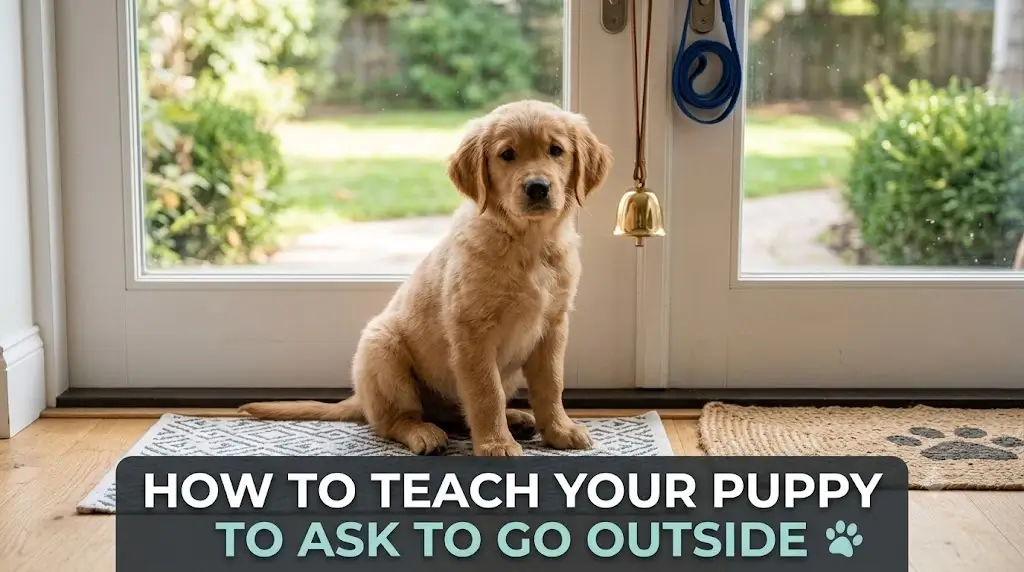
How to Teach a Puppy to Ask to Go Outside: Step-by-Step Potty Signaling
Teaching a puppy to ask to go outside gives the dog a simple way to communicate a bathroom need. The most reliable approach is to choose one clear signal, connect that signal to the door and outdoor bathroom trip, and practice the same sequence every time.
Quick Answer: How Do You Teach a Puppy to Ask to Go Outside?
Choose one simple signal that your puppy can perform reliably. A bell beside the door is one option, but a puppy can also learn to sit by the door, touch a target, or perform another consistent behavior.
- Choose one potty signal.
- Teach the puppy how to perform the signal.
- Place the signal at the exit you use for bathroom trips.
- Immediately take the puppy outside after the signal.
- Go directly to the designated bathroom area.
- Reward successful communication and appropriate elimination.
- Repeat the same sequence until the signal becomes predictable.
The important point is that the signal should communicate a bathroom trip. It should not replace the puppy’s normal age-appropriate potty schedule.
What Is a Puppy Potty Signal?
A potty signal is a behavior the puppy performs to communicate that it needs access to its bathroom area.
The signal does not have to be complicated. The key is that the behavior is easy for the puppy to perform and easy for the owner to recognize.
Common examples include:
- Ringing a bell.
- Touching a hanging bell or target.
- Sitting near the exit.
- Standing by the door.
- Looking toward the door and then toward the owner.
- Touching a designated target near the door.
The best system is usually the one that your household can recognize consistently.
Core principle: The puppy does not need to learn the English concept of “I need to potty.” It needs to learn that a specific behavior reliably produces a bathroom trip.
Best Ways for a Puppy to Ask to Go Outside
| Signal | Advantages | Potential drawback | Best for |
|---|---|---|---|
| Door bell | Easy for owners to hear and easy to place near the exit. | Some puppies may ring it for outdoor access rather than elimination. | Homes where an audible signal is useful. |
| Sitting by the door | No equipment required. | Can be difficult to notice if the owner is in another room. | Quiet households and attentive owners. |
| Door target | Creates a specific visual behavior. | Requires teaching a target behavior. | Owners who prefer a structured signal. |
| Touching a hanging target | Simple physical behavior with an obvious location. | Requires consistent positioning. | Puppies that enjoy touch-based training. |
There is no universal requirement to use a bell. Consistency matters more than the particular object.
How to Teach a Puppy to Use a Bell to Go Outside
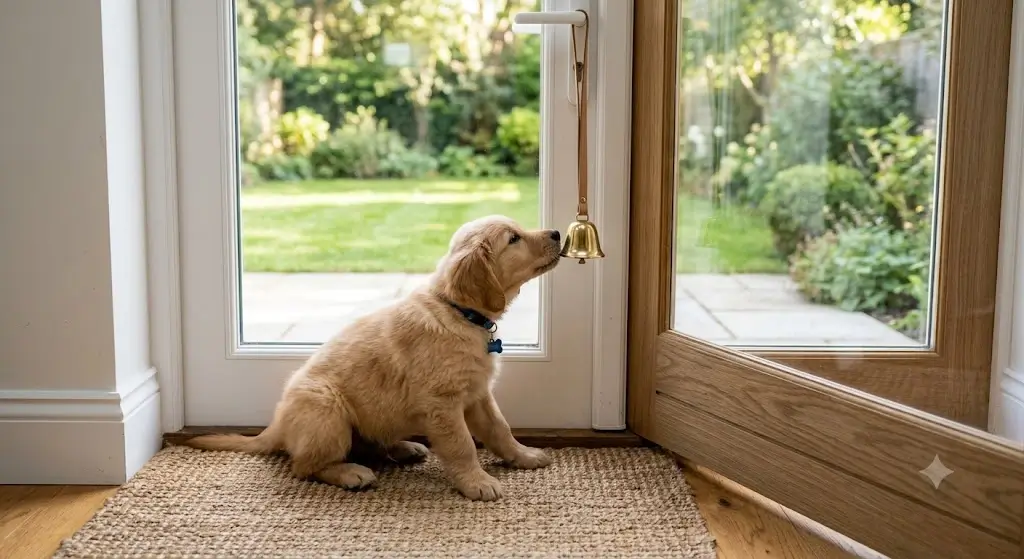
Bell training works by creating a predictable chain:
Touch bell → door opens → outside → bathroom opportunity → reinforcement
The puppy first learns that touching the bell has a consequence. Repeated pairing then gives the bell a functional meaning within the house-training routine.
Step 1: Put the bell beside the exit
Place the bell at a height and position the puppy can reach safely. Everyone in the household should use the same exit when practical.
Step 2: Teach the touch
Encourage the puppy to investigate or touch the bell. When the puppy makes the desired contact, provide immediate positive reinforcement.
Step 3: Connect the bell with the door
Before taking the puppy outside for a planned bathroom trip, prompt the bell behavior.
Step 4: Open the door immediately
The connection should be clear: bell first, door second.
Step 5: Go directly to the bathroom area
Keep the initial outdoor routine focused so the puppy learns that the signal is associated with bathroom access.
How to Teach a Puppy to Sit by the Door
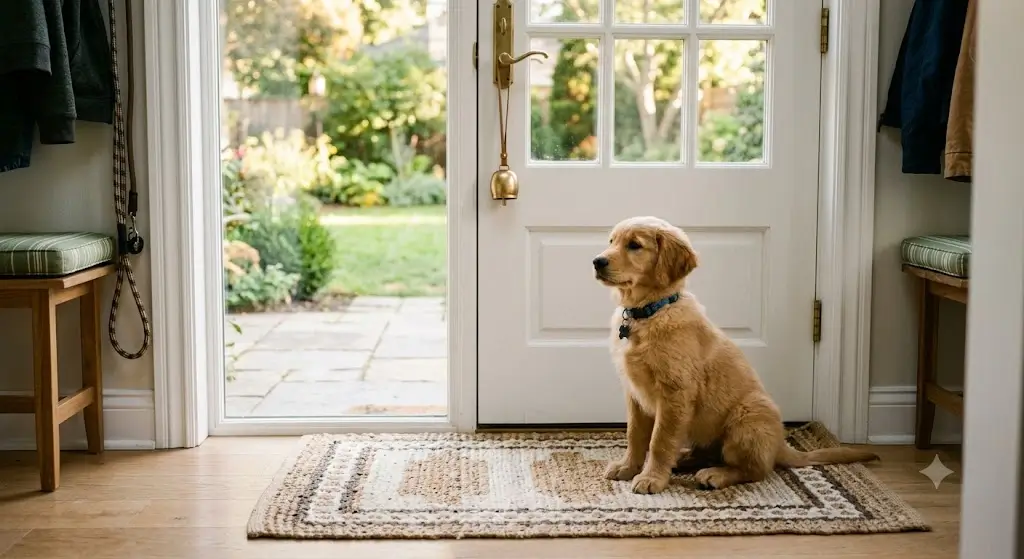
A door signal is useful if you do not want to use a bell.
Start by taking the puppy to the same exit whenever a planned bathroom trip is due. Ask for or wait for the chosen behavior, such as sitting, then immediately open the door and proceed outside.
Over time, the puppy can begin offering the behavior without being prompted.
Keep the signal specific.“Standing somewhere near the kitchen” is difficult for an owner to interpret. “Sitting on the mat beside the back door” is much clearer.
How to Teach a Puppy to Touch a Potty Target
A target gives the puppy a defined object to interact with.
The target could be a small mat, hanging object, button-style training target, or another safe item positioned near the exit.
- Introduce the target in a quiet environment.
- Reward investigation of the target.
- Shape the behavior toward a deliberate nose or paw touch.
- Move the target gradually toward the exit.
- Pair the target touch with the outdoor bathroom routine.
The target should remain consistent. Moving it around the house can make the signal harder for the puppy to understand.
Step-by-Step: Teach Your Puppy to Ask to Go Outside
-
Choose one signal
Pick a bell, door sit, target touch, or another simple behavior. Avoid changing the signal every few days.
-
Make the signal easy to perform
Position the signal where the puppy can reach it safely without climbing, jumping, or performing an awkward movement.
-
Practice before planned bathroom trips
When you already know the puppy needs a bathroom break, prompt the selected signal before opening the door.
-
Open the door immediately
A short delay makes the relationship harder for a young puppy to understand. Keep the sequence predictable.
-
Go directly to the bathroom location
Especially during the learning phase, keep the first part of the outdoor trip focused on the bathroom opportunity.
-
Reinforce successful elimination
Use calm, immediate positive reinforcement after the puppy eliminates in the appropriate location.
-
Wait for spontaneous signals
Once the puppy understands the sequence, stop prompting every time and watch for the puppy to initiate the signal.
-
Respond consistently
Everyone who handles the puppy should understand what the signal means and how to respond.
When Should You Practice the Potty Signal?
The easiest time to teach the signal is when a bathroom trip is already appropriate.
Important practice windows include:
- After waking.
- After naps.
- After meals.
- After drinking.
- After active play.
- Before bedtime.
- After periods of excitement.
This is more effective than waiting randomly throughout the day and hoping the puppy happens to need to go.
Do not make the puppy wait for a signal before taking it outside.The signal is being taught alongside normal puppy bathroom management. Young puppies may have limited bladder control and may not yet be able to communicate reliably.
What Should You Do After the Puppy Gives the Signal?
The response should be predictable.
- Acknowledge the signal.
- Move to the exit.
- Open the door.
- Go to the designated bathroom area.
- Give the puppy time to eliminate.
- Reinforce successful elimination.
A consistent response teaches the puppy that the communication behavior has a useful consequence.
How to Reinforce a Puppy for Asking to Go Outside
Reinforcement should be immediate enough for the puppy to connect the behavior with its consequence.
There are actually two behaviors you may want to reinforce:
- Communicating: the puppy performs the signal.
- Eliminating appropriately: the puppy goes in the correct location.
Keeping those behaviors conceptually separate helps explain why a puppy can learn to ring a bell but still need more house-training practice.
Use calm, consistent reinforcement
Praise, attention, and an appropriate reward can all be used according to what motivates your puppy and fits your existing training system.
What If My Puppy Rings the Bell Just to Go Outside?
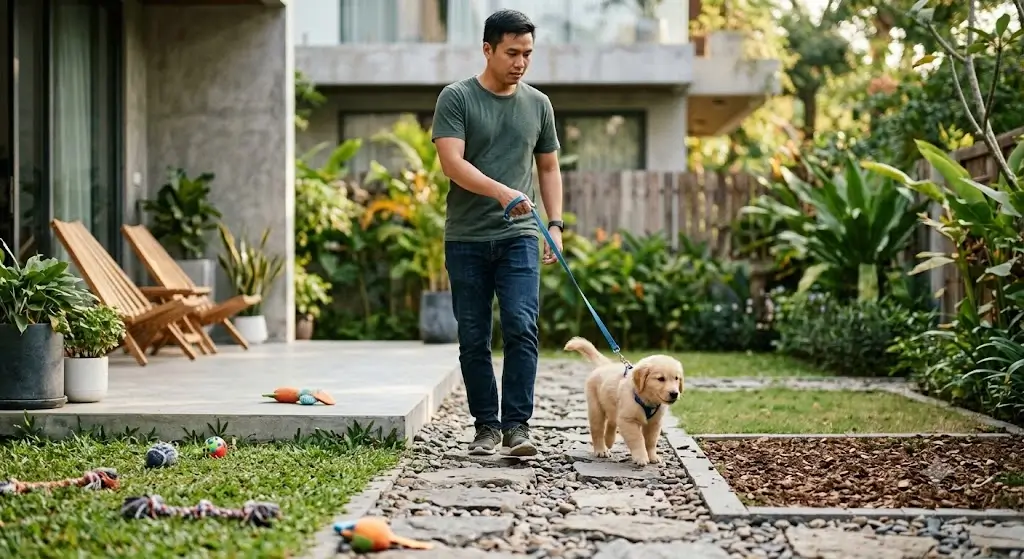
This is one of the most common complications with an audible potty signal.
Once the puppy learns that ringing the bell opens the door, it may discover that the same behavior produces access to the outdoors.
That does not necessarily mean the training has failed. It means the puppy has learned the broader consequence of the signal.
How to preserve the potty meaning
- Respond calmly to the signal.
- Take the puppy to the normal bathroom location first.
- Give a reasonable opportunity to eliminate.
- Avoid turning every signal into a long outdoor play session.
- Continue using the same signal for genuine bathroom needs.
If the puppy frequently asks to go outside immediately after already eliminating, evaluate whether the signal has become an attention or outdoor-access behavior.
What If the Puppy Still Has Accidents?
Accidents do not necessarily mean the communication training is failing.
A puppy can understand the signal but still lack the physical control needed to wait for the owner to respond. To set realistic expectations around holding capacity, check our guide on how long a puppy can hold its bladder.
Other possibilities include:
- The puppy was given too much freedom.
- The interval between bathroom trips was too long.
- The puppy did not yet recognize its own signal.
- The owner missed a subtle signal.
- The puppy became distracted or excited.
- The puppy’s routine changed.
Return to proactive management rather than expecting the signal to solve every accident immediately.
Why a Potty Signal Does Not Replace a Puppy Potty Schedule
This distinction is critical.
A potty signal teaches communication. A potty schedule provides opportunities before the puppy reaches the point of urgency. If you need a structured daily routine to follow, use our 7-day puppy house training plan.
Young puppies should still be taken outside based on age, waking, eating, drinking, naps, play, and other predictable triggers.
How to Teach a Puppy to Ask to Go Outside at Night
Nighttime training requires a different expectation because very young puppies may not yet be able to remain dry for the entire night.
Keep the signal available near the nighttime exit if practical, but do not expect a young puppy to reliably wake, reach the signal, and communicate before every accident.
If the puppy wakes and shows signs that it needs to eliminate, take it outside promptly and keep the nighttime trip calm and predictable.
Nighttime priority: Meet the puppy’s developmental bathroom needs first. Signal training can become more reliable as the puppy gains bladder control and learns the household routine. Learn how to establish reliable indoor habits in our complete guide on how to house train a puppy.
How Long Does It Take to Teach a Puppy a Potty Signal?
There is no universal number of days because the process depends on the puppy, the signal, the consistency of the household, and how often the behavior is practiced.
Early progress may appear as the puppy beginning to approach the signal before a bathroom trip. Later, the puppy may independently perform the behavior when it needs access outside.
Signs the signal is becoming meaningful
- The puppy approaches the signal without being prompted.
- The signal occurs shortly before genuine bathroom needs.
- The puppy looks toward the owner after performing it.
- Accidents decrease as communication improves.
- The behavior remains consistent across different days.
Reliability matters more than speed. A signal that works consistently is more useful than one learned quickly but used inconsistently.
Puppy Potty Signal Troubleshooting
| Problem | Likely training issue | What to change |
|---|---|---|
| Puppy ignores the bell | The signal has not been taught as a behavior. | Teach the touch separately before attaching it to the door routine. |
| Puppy only rings when prompted | The puppy has learned the prompted sequence but not independent initiation. | Pause and watch for spontaneous behavior during predictable potty windows. |
| Puppy rings constantly | The signal may have become associated with outdoor access. | Make bathroom trips predictable and keep post-potty outings structured. |
| Accidents continue | The puppy may still lack bladder control or the schedule may be too loose. | Increase proactive trips and supervision. |
| Owners miss the signal | The signal is too subtle or occurs in an inconvenient location. | Use a more noticeable signal or keep the puppy closer during training. |
| Signal works at one door only | The puppy has learned a location-specific behavior. | Generalize gradually to other exits if needed. |
How to Generalize the Signal to a New Door
A puppy may initially learn that one particular bell or door predicts outside access. If you move to another home or begin using another exit, the behavior may need to be rebuilt.
- Place the familiar signal near the new exit.
- Prompt the behavior before planned bathroom trips.
- Immediately follow the signal with the outdoor routine.
- Repeat until the puppy begins offering the behavior independently.
- Only then consider changing or simplifying the signal.
This is an example of why the communication behavior should be taught as a clear cue rather than relying on a particular physical doorway alone.
Should You Teach More Than One Potty Signal?
Usually, one primary signal is easier for a young puppy and household to understand.
Multiple signals can eventually be useful, especially in a large home, but adding several behaviors too early can make it harder to determine what the puppy is actually being reinforced for.
Start with one clear behavior. Add another only when the first signal is already reliable.
Key Takeaways
- A potty signal is a communication behavior, not a replacement for bladder development.
- Bells, sitting by the door, touching a target, and similar behaviors can all work.
- Choose one signal that your puppy can perform easily and your household can recognize.
- Practice the signal immediately before planned bathroom trips.
- After the signal, respond consistently and take the puppy to the designated bathroom area.
- Reinforce appropriate communication and successful elimination.
- Do not wait for a young puppy to signal before every bathroom trip.
- If a bell becomes an “I want to play outside” button, keep the response structured rather than abandoning the training immediately.
- Continued accidents may indicate that the puppy needs more frequent bathroom opportunities, closer supervision, or additional house training.
Frequently Asked Questions
How do I teach my puppy to ask to go outside?
Choose one consistent signal, such as a bell by the door, teach the puppy to perform that signal, immediately open the door and take the puppy to the bathroom area, then reinforce successful communication and elimination.
How do I teach a puppy to use a bell to go outside?
Place the bell near the exit, teach the puppy to touch or ring it, immediately take the puppy outside after the signal, and repeat the same sequence consistently until the bell becomes associated with going outside.
When should I start teaching my puppy a potty signal?
A potty signal can be introduced while you are already house training the puppy. The puppy should still receive frequent scheduled bathroom opportunities because a signal is a communication skill, not a replacement for developmental bladder control.
What if my puppy rings the bell just to go outside?
Keep the response calm and consistent. Take the puppy to the designated bathroom area first rather than turning every bell ring into an extended play session. This helps preserve the meaning of the signal.
Can a puppy learn to sit by the door to ask to go outside?
Yes. Sitting, standing, touching a target, looking toward the door, or using a bell can all become communication signals if the owner consistently responds to the same behavior.
Should I wait for my puppy to ask before taking it outside?
No. Young puppies still need proactive bathroom opportunities based on age, waking, meals, drinking, play, naps, and other predictable triggers. Waiting for a signal can lead to accidents before the puppy has reliable control.
Why does my puppy not tell me when it needs to potty?
The puppy may not yet understand the communication behavior, may have limited bladder control, may not recognize the signal’s purpose, or may be receiving inconsistent responses. Continue proactive bathroom trips while teaching the signal.
What is the best potty signal for a puppy?
The best signal is one that is easy for the puppy to perform, easy for the household to notice, and used consistently. Bells, door sitting, touching a target, and other simple signals can work.
