
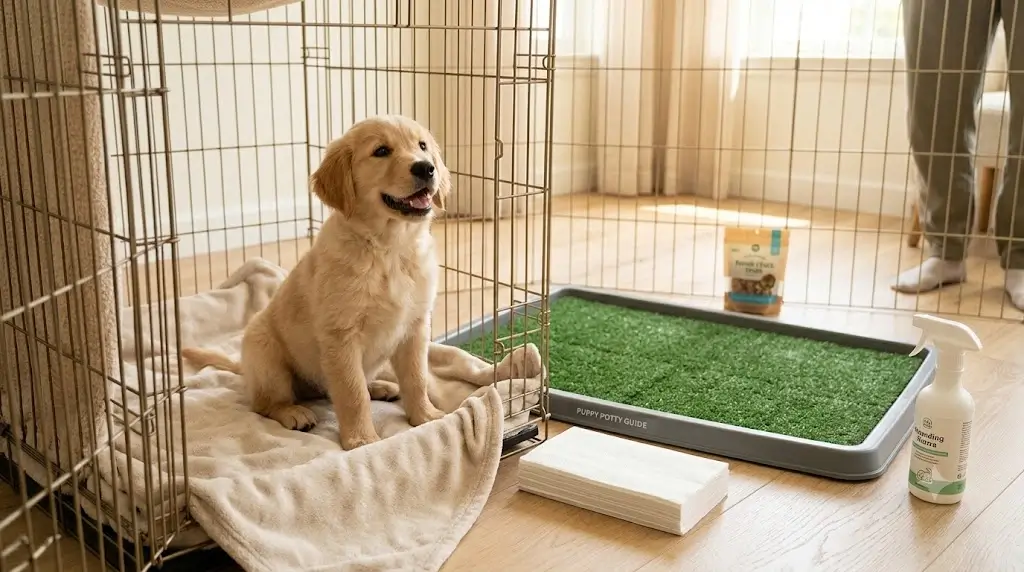
Follow this practical seven-day puppy house training plan to establish a predictable bathroom routine, increase successful potty trips, reinforce the correct location, manage accidents, and gradually increase your puppy’s freedom.
A practical seven-day training framework based on management, reinforcement, supervision, and measurable progress rather than a promise that every puppy will be fully house trained in exactly one week.
Quick Answer: Can You House Train a Puppy in 7 Days?
Seven days can be enough to establish a strong house-training routine, but there is no universal one-week deadline for every puppy.
The purpose of this plan is to create seven consecutive days of consistent management: frequent bathroom opportunities, immediate reinforcement, close supervision, controlled freedom, and thorough accident cleanup.
A puppy that makes major progress during the first week may still need additional weeks of reinforcement before becoming reliable throughout the entire home.
HOUSE TRAINING ESSENTIAL
Get Your Puppy Training Setup Ready
Starting a seven-day training plan is easier when your basic supplies are ready before the first bathroom trip. We look for practical products that help with supervision, rewards, cleanup, and everyday puppy management.
See the Puppy Training Program →
Instant Access • Step-by-step Video Modules
7-Day Plan at a Glance
- Day 1: Set Up the System
- Day 2: Reinforce the Bathroom Location
- Day 3: Build Predictability
- Day 4: Recognize Pre-Potty Signals
- Day 5: Add Controlled Freedom
- Day 6: Test Real-Life Conditions
- Day 7: Evaluate Progress
- Sample Daily Schedule
- Accident Management
- Increasing Freedom
- Troubleshooting
- FAQ
How This 7-Day Puppy House Training Plan Works
The biggest mistake with short house-training programs is treating the number seven as a deadline rather than a defined training block.
Seven days gives you a structured period during which you can make the puppy’s environment predictable and collect useful information about bathroom timing, signals, accidents, successful trips, and the amount of freedom the puppy can currently handle.
| Variable | What You Control | Why It Matters |
|---|---|---|
| Timing | Bathroom opportunities | Creates more opportunities to reinforce successful behavior. |
| Location | Consistent bathroom area | Helps establish a clear location rule. |
| Supervision | Direct observation or controlled confinement | Reduces opportunities for unsupervised accidents. |
| Reinforcement | Reward after successful elimination | Makes the desired behavior more valuable to the puppy. |
| Freedom | Access to rooms | Prevents giving the puppy more responsibility than it can handle. |
Before Day 1: Prepare the House
The first day becomes much easier when the environment is prepared before training begins.
- Choose the puppy’s designated bathroom location.
- Decide whether the long-term goal is outdoor elimination, an indoor pee pad, or another defined bathroom system.
- Prepare small, appropriate rewards.
- Set up a crate or safe confinement area if you use one.
- Restrict access to rooms that cannot be supervised.
- Keep an appropriate enzymatic cleaner available for accidents.
- Prepare a simple record for successful trips and accidents.
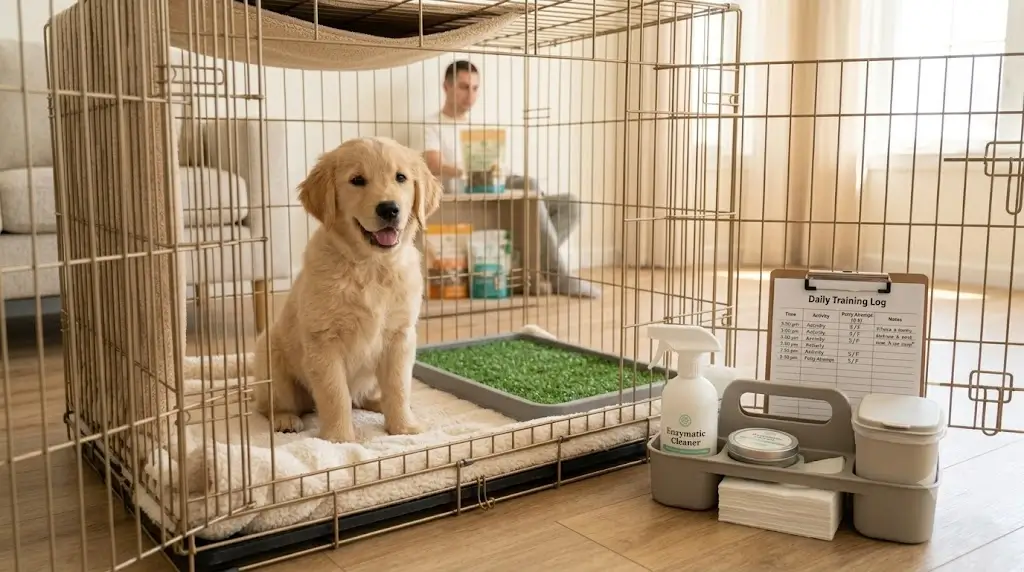
The objective is to make the correct bathroom behavior easier to perform than the incorrect behavior.
Day 1
Set Up the System and Prevent Mistakes
Day 1 is primarily a management day. Do not focus on giving the puppy unrestricted access to the home.
Keep the puppy close enough that you can notice changes in behavior. When you cannot supervise directly, use an appropriate controlled area rather than allowing the puppy to wander.
Day 1 checklist
- Take the puppy to the designated bathroom area after waking.
- Reward successful elimination promptly.
- Provide additional bathroom opportunities around meals, drinking, naps, and active play.
- Record successful trips and accidents.
- Clean accidents thoroughly if they occur.
- Keep freedom inside the house limited.
Your main objective is information. By the end of Day 1, you should have a better idea of when your puppy tends to need a bathroom trip.
Day 2
Reinforce the Correct Bathroom Location
Day 2 focuses on making the bathroom location meaningful.
Bring the puppy to the same general area whenever possible. Keep your behavior calm while waiting.
Avoid showing the reward too early if doing so distracts the puppy. The desired behavior should happen first.
Day 3
Build Predictability Around Daily Events
Puppies do not eliminate according to a universal schedule. A more useful approach is to combine the clock with events that can change bathroom needs.
- Waking up.
- Eating.
- Drinking.
- Napping.
- Active play.
- Exciting activity.
- Before bedtime.
Record what actually happens rather than assuming that every puppy needs exactly the same interval.
Day 4
Teach the Puppy to Notice the Bathroom Routine
Look for behaviors that occur before elimination.
- Suddenly stopping play.
- Sniffing the floor.
- Moving away from people.
- Circling or searching for a location.
- Moving toward a door.
- Becoming restless.
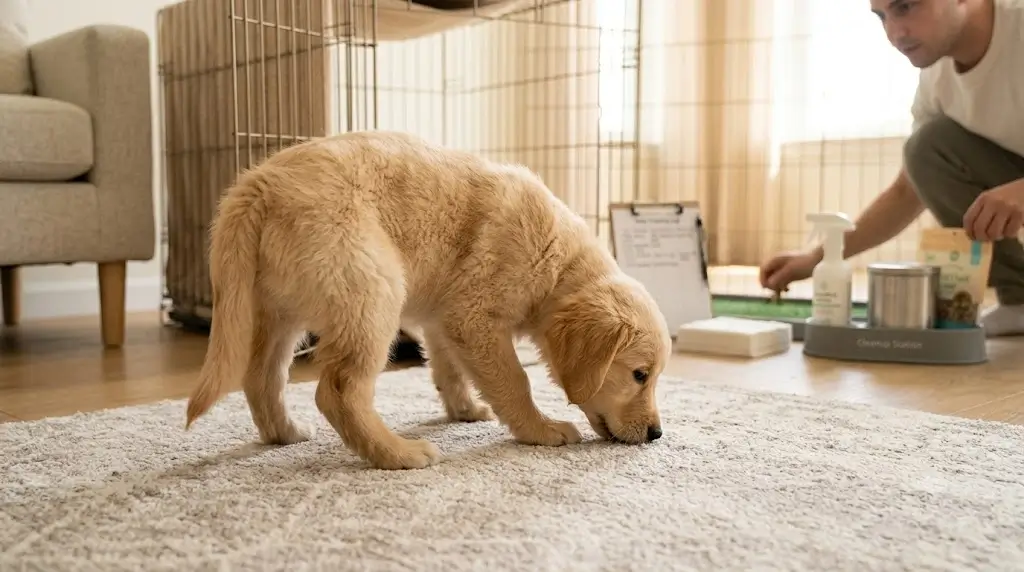
These signals vary between puppies. Do not wait for a dramatic signal before providing a bathroom opportunity.
If you see a useful signal, respond promptly and guide the puppy to the appropriate location.
Day 5
Add Controlled Freedom
Freedom should be earned through behavior, not awarded simply because it is Day 5.
If the puppy has been consistently successful under supervision, allow access to one additional area while maintaining observation.
If accidents increase, reduce freedom again.
If more space produces more accidents, the puppy is not necessarily failing. The environment may simply be ahead of the puppy’s current skill level.
Day 6
Test the Routine Under Real-Life Conditions
House training has to work outside a quiet training session.
Introduce realistic distractions while maintaining enough supervision to prevent avoidable mistakes.
- Family activity.
- Short periods of independent rest.
- Normal meal preparation.
- Supervised play.
- Moving between rooms.
- Normal household sounds.
Continue rewarding successful bathroom trips.
Day 7
Evaluate Progress and Build the Next Week
Day 7 is not a graduation ceremony. It is an evaluation point.
Review your notes from the previous six days.
Ask these questions
- How many successful bathroom trips occurred?
- When did accidents happen?
- Were accidents associated with particular activities?
- Does the puppy show predictable pre-potty behavior?
- Does the puppy perform better with restricted freedom?
- Does the puppy respond well to the chosen reward?
- Can you increase freedom without a major increase in accidents?
Your answers determine the next stage better than the number of days on the calendar.
Sample Daily Puppy House Training Schedule
This schedule is a framework rather than a fixed prescription. Individual puppies need different bathroom opportunities.
| Event | What to Do | Training Objective |
|---|---|---|
| Wake-up | Go directly to the bathroom location. | Reinforce morning success. |
| After breakfast | Provide another bathroom opportunity. | Connect meals with the routine. |
| After nap | Guide the puppy to the bathroom area. | Prevent post-sleep accidents. |
| After active play | Offer a bathroom opportunity. | Account for changes after activity. |
| Before confinement | Provide a bathroom opportunity. | Start the rest period with an appropriate routine. |
| Before bedtime | Complete the planned bathroom trip. | Establish a predictable nighttime routine. |
How to Reward Your Puppy During the 7-Day Plan
The reward should follow successful elimination rather than precede it.
During the early part of the plan, consistent reinforcement can help establish a clear connection between the desired behavior and its consequence.
- Guide the puppy to the correct bathroom location.
- Wait calmly.
- Allow elimination to finish.
- Deliver a small, appropriate reward promptly.
- Continue normal activity.
Food treats are convenient, but praise, play, or access to a preferred activity may also function as reinforcement depending on the puppy.
ACCIDENT CLEANUP
Prepare for Puppy Accidents Before They Happen
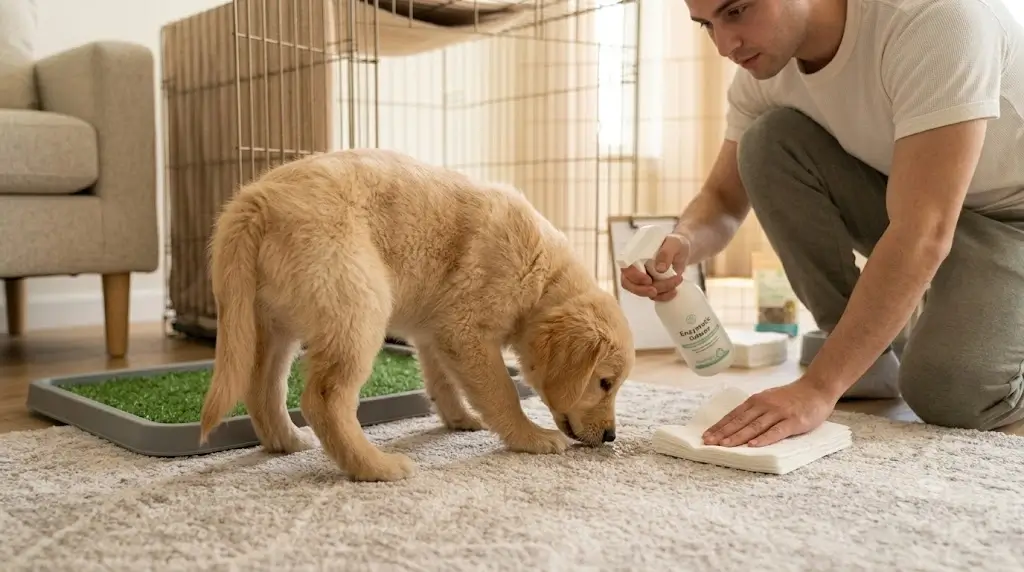
Even a well-managed first week can include accidents. Having the appropriate cleanup supplies ready helps you respond quickly without turning an accident into a training setback.
See the Puppy Training Program →
Instant Access • Step-by-step Video Modules
What to Do If Your Puppy Has an Accident
Accidents during the first week do not automatically mean the training plan is failing.
Treat them as information about timing, supervision, freedom, or the puppy’s current development.
If you see the accident starting
- Interrupt calmly if needed.
- Guide the puppy to the appropriate bathroom location.
- Reward successful completion there.
If you discover an accident later
- Do not punish the puppy.
- Clean the area thoroughly.
- Identify what happened immediately before the accident.
- Adjust supervision or bathroom timing.
- Continue reinforcing successful trips.
If a puppy that was doing well suddenly begins having frequent accidents, especially with signs of pain, straining, blood in urine, unusual thirst, lethargy, vomiting, diarrhea, or other concerning symptoms, seek veterinary guidance.
How to Increase Your Puppy’s Freedom After the 7 Days
The end of the seven-day plan should not automatically mean full access to the house.
Expand the puppy’s territory gradually based on actual performance.
| Current Performance | Recommended Response |
|---|---|
| Frequent accidents | Increase supervision and reduce freedom. |
| Occasional accidents | Maintain current management and improve timing. |
| Reliable under supervision | Test one additional area. |
| Reliable across multiple rooms | Gradually increase supervised freedom. |
Performance, rather than the calendar, should determine how quickly freedom expands.
Adapting the 7-Day Plan for an Apartment or Home Without a Yard
The same seven-day framework can be used in an apartment, townhouse, condo, or home without direct yard access.
The main difference is travel time between the puppy and the bathroom location.
If the puppy must travel through hallways, elevators, or stairs, plan the trip before the puppy reaches the point of urgency.
For indoor systems, define one consistent bathroom area and reinforce successful use of that location.
- House Training a Puppy in an Apartment
- House Training a Puppy Without a Yard
- Indoor House Training for Puppies
What If You Work Full Time?
A seven-day plan is harder to execute when a puppy is alone for long periods because supervision and bathroom opportunities become limited.
The answer is not to expect a puppy to hold it simply because the training calendar says so.
Depending on the household, owners may need appropriate help from a family member, pet sitter, dog walker, or another responsible caregiver.
How Nighttime Fits Into the 7-Day Plan
Nighttime house training should be treated separately from daytime training because the puppy is sleeping rather than actively moving around the house.
Establish a predictable bedtime routine and provide a bathroom opportunity before sleep.
Young puppies may still require nighttime bathroom management. An accident during sleep should not be treated as deliberate disobedience.
7-Day Puppy House Training Troubleshooting
My puppy has several accidents every day.
Increase bathroom opportunities and supervision. Reduce access to unsupervised areas and review the circumstances surrounding each accident.
My puppy goes outside but does not eliminate.
Keep the bathroom trip calm and focused. Give the puppy a reasonable opportunity to eliminate before returning to normal activity.
My puppy immediately has an accident after coming inside.
The puppy may not have finished, or the bathroom opportunity may have been too short. Keep the puppy under close supervision after returning indoors and provide another opportunity when appropriate.
My puppy does well in one room but has accidents elsewhere.
The puppy may have learned a location-specific habit rather than a generalized house-training rule. Expand access gradually and continue reinforcing successful behavior in different areas.
My puppy was improving but suddenly regressed.
Review recent changes in routine, freedom, environment, supervision, feeding, activity, or household schedule. If the change is sudden or accompanied by other symptoms, consult a veterinarian.
Printable 7-Day Puppy House Training Checklist
| Day | Main Objective | Complete? |
|---|---|---|
| Day 1 | Set up management and identify bathroom patterns. | ☐ |
| Day 2 | Reinforce the correct bathroom location. | ☐ |
| Day 3 | Build predictable event-based bathroom opportunities. | ☐ |
| Day 4 | Recognize and respond to pre-potty signals. | ☐ |
| Day 5 | Test a small increase in freedom. | ☐ |
| Day 6 | Practice under normal household conditions. | ☐ |
| Day 7 | Evaluate progress and create the next training block. | ☐ |
PUPPY HOUSE TRAINING ESSENTIAL
Ready to Start Your 7-Day Training Plan?
Having a structured, expert-guided routine makes the first week easier to manage. Follow step-by-step video lessons and avoid common house-training mistakes.
Get the 7-Day Potty Training Program →
Instant Online Access • Lifetime Updates
Frequently Asked Questions
Can you house train a puppy in 7 days?
A seven-day plan can establish a strong routine and improve consistency, but it does not guarantee that every puppy will be fully house trained in one week. Age, previous training, health, supervision, environment, and individual development all affect the timeline.
What should I do on the first day of puppy house training?
Set up the bathroom location, establish supervision and confinement rules, begin predictable bathroom opportunities, and reward successful elimination immediately.
How often should I take a puppy outside during the 7-day plan?
Bathroom opportunities should be based on the puppy’s age, individual needs, sleep, meals, drinking, play, and observed signals rather than one universal interval.
Should I use treats during a 7-day puppy house training plan?
Small, appropriate rewards can help reinforce successful elimination, particularly during early training. Rewards should be delivered promptly after the desired behavior.
What should I do if my puppy has an accident during the seven days?
Clean the area thoroughly, avoid punishment, review what happened before the accident, increase supervision or bathroom opportunities if necessary, and continue rewarding successful elimination.
When should I give my puppy more freedom in the house?
Increase freedom gradually after the puppy demonstrates reliable bathroom behavior under the current level of supervision. A calendar day alone should not determine how much freedom the puppy receives.
Does a seven-day plan work for older puppies?
The same seven-day structure can be useful for older puppies, but the starting point may differ if the puppy already has established habits or has experienced repeated accidents.
What if my puppy is not house trained after seven days?
Continue the same training principles beyond the first week. Seven days should be treated as an initial training block, not a deadline. If accidents are persistent or there are sudden changes in elimination, discuss the situation with a veterinarian.
