
AKC & AVMA PEDIATRIC PROTOCOLS 2026
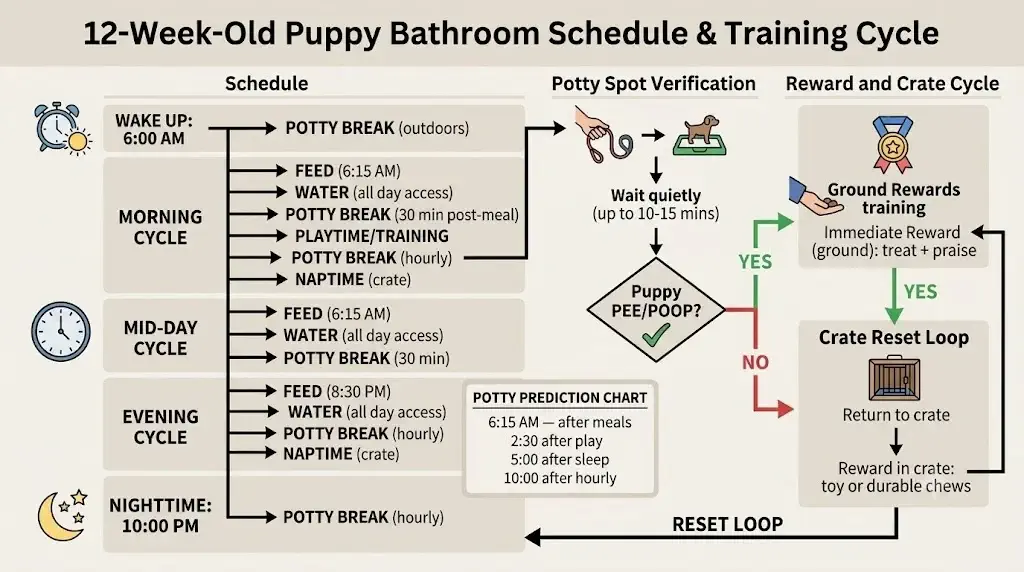
12-Week-Old Puppy Bathroom Schedule
A 12-week-old puppy demonstrates expanding anatomical bladder capacity and strengthening internal urethral sphincter control, yet domestic reliability still demands proactive scheduling. At three months of age, neuromuscular coordination enables clearer pre-elimination body signaling, while kidneys begin filtering fluids with greater metabolic efficiency. Successfully executing a 12-week-old puppy bathroom schedule requires balancing structured 90-to-120-minute daytime intervals with biological transitions—waking from deep naps, post-prandial digestion, hydration intake, vigorous exercise, and nighttime crating.
Quick Reference Specification: 12-Week-Old Puppy Potty Matrix
This calibrated physiological matrix benchmarks developmental milestones, biological mechanisms, tactical interventions, maximum holding capacities, and veterinary safety standards for a 12-week-old puppy bathroom schedule in 2026.
| Developmental Event / Phase | Physiological Mechanism | Tactical Potty Intervention | Max Bladder Dwell | Safety Benchmark |
|---|---|---|---|---|
| Waking From Nap / Night | Motor arousal releasing detrusor muscle inhibition | Immediate on-leash escort directly to outdoor grass | 0 minutes (Immediate upon waking) | AVMA Pediatric Urology Standard |
| Post-Prandial Digestion | Gastrocolic reflex stimulating lower bowel motility | Outdoor grass trip 15–25 mins post-feeding | 25 minutes post-ingestion | AAHA Juvenile Digestion Standard |
| Vigorous Play & Exercise | Abdominal contraction & sensory masking of bladder | Scheduled potty pause every 30–40 minutes | 40 minutes active play maximum | AKC Juvenile Activity Guidelines |
| Awake Supervised Interval | Maturing striated sphincter muscle tone | Umbilical tethering + 90–120 min schedule timer | 1.5–2.5 hours awake holding | PuppyPottyGuide 3-Month Matrix |
| Overnight Circadian Sleep | Elevated nocturnal ADH pituitary fluid concentration | Bedside crate; sleep through or responsive break | 6–7.5 hours continuous sleep | Fear Free Confinement Standards |
12-Week-Old Puppy Bathroom Schedule at a Glance
Predictable reinforcement patterns establish permanent domestic cleanliness more effectively than forcing maximum bladder holding times. At twelve weeks of age, your puppy possesses improved physiological control, but their nervous system still requires structured environmental boundaries to prevent habituated indoor mistakes.
Structuring an effective routine relies on four core developmental pillars:
Morning
Potty immediately upon waking, then again after breakfast and morning exercise as digestion activates.
Midday
Use crate naps, lunch digestion, deep water drinks, and play pauses as automatic elimination triggers.
Evening
Provide scheduled breaks 20 minutes following dinner kibble and immediately after active family play sessions.
Night
Take the puppy out right before bed and respond to genuine overnight elimination needs without interactive playtime.
Sample 24-Hour 12-Week-Old Puppy Bathroom Schedule
A coordinated 24-hour timetable synchronizes canine metabolic digestion with household working hours. This framework assumes a standard three-meal feeding plan. Adapt these timestamps to match your personal schedule and veterinary nutritional guidelines:
For foundational long-term schedule planning across all puppy stages, consult our comprehensive Puppy House Training Schedule.
How Often Should a 12-Week-Old Puppy Go Potty?
Developing three-month-old canines require outdoor elimination opportunities every 90 minutes to two hours while awake. While renal filtration stabilizes compared to early infancy, active play and metabolic turnover continue to generate fluid volume steadily.
Combining baseline time intervals with biological event triggers provides complete coverage:
Layer 1: Routine Clock Trips
Use structured 90-to-120-minute daytime intervals while the puppy is awake to prevent urgency thresholds from being breached.
Layer 2: Biological Event Trips
Add automatic outdoor breaks immediately upon waking, post-feeding, after deep water drinking, and following active play.
To compare developmental baselines with younger milestones, review our protocol for a 10-Week-Old Puppy Bathroom Schedule.
12-Week-Old Puppy Potty Schedule After Waking
Motor arousal following sleep releases parasympathetic bladder inhibition within sixty seconds of waking. Whether waking from an overnight rest or a two-hour midday crate nap, a 12-week-old puppy faces immediate detrusor muscle activation.
Never permit unmonitored wandering across living room carpets after waking. Follow this standard four-step transition:
Open the crate door immediately; attach the leash without lingering to talk or stretch indoors.
Walk briskly on a 6-foot fixed leash directly to the outdoor turf area; maintain a consistent route.
Stand stationary in the relief area for three to five minutes; avoid engaging in active play.
Deliver a high-value treat within three seconds of voiding completion, paired with calm verbal praise.
12-Week-Old Puppy Bathroom Schedule After Meals
Gastric distension stimulates involuntary colonic contractions via the gastrocolic reflex within fifteen to twenty-five minutes. At twelve weeks, juvenile digestive transit becomes more predictable, making post-prandial bowel movements easy to schedule.
| Meal Event | Tactical Housebreaking Strategy |
|---|---|
| Breakfast (6:45 AM) | Keep tethered post-bowl; escort to grass at 7:15 AM to capture morning bowel evacuation. |
| Lunch (12:00 PM) | Provide outdoor relief break at 12:25 PM; avoid waiting for indoor pacing signals. |
| Dinner (5:30 PM) | Schedule grass trip at 5:50 PM; follow with an additional break after evening play. |
Maintain consistent feeding times every day rather than shifting meal hours. Predictable nutritional schedules create predictable elimination habits.
How Drinking Affects a 12-Week-Old Puppy Bathroom Schedule
Systemic fluid absorption processes oral hydration into bladder volume within twenty to thirty minutes. Withholding drinking water to prevent housebreaking accidents is medically inappropriate and risks dangerous dehydration.
Provide unrestricted access to clean water throughout active daylight hours. When your 12-week-old puppy laps up significant water following exercise, start a 25-minute mental timer and escort them outdoors before urgency peaks. If unquenchable thirst (polydipsia) or frequent urination develops suddenly, consult a veterinarian to rule out clinical conditions.
Why Playtime Belongs in the Bathroom Schedule
Vigorous physical movement compresses visceral abdominal organs and accelerates urine accumulation. During enthusiastic bouts of fetch, tug-of-war, or puppy zoomies, sensory excitement overrides conscious bladder awareness.
Interrupt active play every 30 to 40 minutes for a prompt outdoor break. The moment a puppy abruptly stops playing or disengages to sniff flooring, escort them straight outside.
How Long Can a 12-Week-Old Puppy Hold Its Bladder?
Quiet resting states permit up to six hours of holding capacity, while active awake periods cap retention at roughly two to three hours. While the conventional rule of thumb (months of age plus one) indicates four hours for a 12-week-old pup, this metric applies primarily during sedentary crate rest.
If indoor accidents consistently happen at the two-hour mark, shorten daytime intervals to 90 minutes and maintain direct visual supervision.
Does a 12-Week-Old Puppy Need to Go Potty at Night?
Circadian pituitary secretion of anti-diuretic hormone allows many twelve-week-old puppies to sleep seven hours uninterrupted. Individual development varies; some puppies comfortably sleep from 10:30 PM to 6:00 AM, while others still require a single overnight relief break around 3:30 AM.
If your puppy wakes and whines softly after five hours of sleep, provide a silent, business-only trip outside. Keep lights off, avoid talking, and return them straight to their sleeping quarters once finished. For full nocturnal protocols, review our dedicated guide on the Puppy Bathroom Schedule at Night.
12-Week-Old Puppy Overnight Bathroom Schedule
A standardized nocturnal routine supports undisturbed crate sleep and prevents behavioral waking habits. Follow this overnight framework:
| Timestamp | Nocturnal Protocol Action |
|---|---|
| 9:30 PM | Calm wind-down period; lift main water bowl; quiet interactive bonding[cite: 1, 2]. |
| 10:30 PM | Final pre-bed elimination trip on-leash; reward voiding; latch bedroom crate door. |
| Overnight (Optional) | Respond silently if the puppy whimpers; avoid proactive alarms if the puppy sleeps cleanly. |
| 6:30 AM | Morning wake-up; proceed directly outdoors to start the daytime bathroom schedule. |
Do not wake a sleeping 12-week-old puppy simply to meet an arbitrary timetable if they consistently remain dry until morning.
Signs Your 12-Week-Old Puppy Needs to Go
Subtle pre-elimination behavioral shifts provide visible warnings before indoor accidents occur. At twelve weeks, puppies communicate elimination pressure through recognizable body language cues:
- Abruptly abandoning a favorite chew toy or pausing active play.
- Lowering head posture and sniffing carpet fibers intensely.
- Tight, repetitive circling in a localized room area.
- Restless pacing along walls, room perimeters, or baby gates.
- Walking away from family members toward hallways or exit doors.
- Soft whining paired with intense eye contact.
- Returning to areas where previous accidents occurred.
How to Tell Whether Your Puppy Is Ready for Longer Potty Intervals
Documented strings of accident-free days indicate physiological readiness to extend intervals. Never extend holding times solely because a puppy reached three months of age; assess these objective behavioral indicators:
| Observed Behavioral Milestone | Recommended Management Decision |
|---|---|
| Consistent dryness over 7 consecutive days | Safely extend awake intervals by 15 minutes (e.g., from 90 to 105 mins). |
| Eliminates immediately upon reaching grass | Substrate preference is firm; maintain high-value ground reinforcement. |
| Exhibits recognizable pre-potty signaling | Begin pairing behavioral cues with timer-based scheduled breaks. |
| Accidents occur right before scheduled breaks | Current interval is too demanding; reduce timer by 20 minutes immediately. |
| Puddles appear when room access expands | Freedom was granted prematurely; restrict territory to one supervised zone. |
How to Increase Potty Intervals Without Causing Setbacks
Gradual fifteen-minute increments test bladder holding limits without triggering behavioral regressions. Expanding intervals too aggressively leads to avoidable indoor accidents:
Verify the puppy has remained 100% accident-free under their current 90-minute schedule for seven straight days.
Lengthen the daytime awake interval from 90 minutes to 105 minutes while keeping all wake-up and meal trips identical.
Never delay immediate post-nap, post-meal, or post-play outdoor trips regardless of clock timing.
If accidents appear during the extended window, drop back to the 90-minute schedule for one full week before retrying.
How Much House Freedom Should a 12-Week-Old Puppy Have?
Unmonitored household exploration remains the leading cause of preventable housebreaking setbacks. A 12-week-old puppy may possess improved control, but they still lack the cognitive responsibility to manage unrestricted household territory.
Supervised Active Zones
Allow freedom in one central living space only while connected to an adult via umbilical leash.
Enclosed Playpen Areas
Use an exercise pen on cleanable floors when direct 100% human visual attention is unavailable.
Unobstructed Transit Routes
Maintain clear hallways and secure baby gates to keep the path to the outdoor exit direct.
Stepwise Territorial Expansion
Open secondary rooms one by one only after multiple consecutive accident-free weeks.
12-Week-Old Puppy Bathroom Schedule and Crate Training
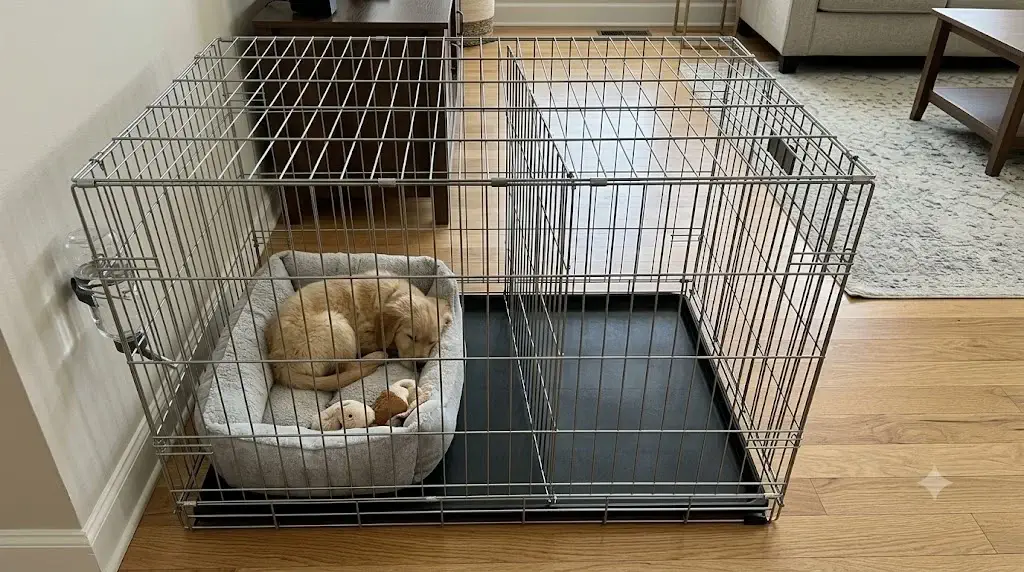
Proper crate sizing leverages innate den instincts to discourage soiling while developing bladder retention. A crate serves as an essential training tool, provided it is sized correctly for your puppy’s rapid physical growth.
Adjust the interior wire divider so the puppy has room to stand up, turn around, and lie down comfortably without extra space[cite: 9]. If the crate is excessively large, a puppy may eliminate in one end and sleep clean in the other[cite: 9]. Always provide an outdoor potty opportunity before crate confinement, and make an outdoor trip the immediate first activity upon opening the crate door.
What If My 12-Week-Old Puppy Keeps Having Accidents?
Frequent indoor eliminations reflect an environmental management breakdown rather than canine stubbornness. At three months, recurring accidents indicate that indoor intervals are too wide or visual supervision has lapsed.
Audit and tighten your housebreaking workflow across these primary operational areas:
- Reduce daytime awake intervals to every 60 to 75 minutes.
- Escort the puppy outside within sixty seconds of waking from any nap.
- Add an automatic outdoor break immediately after 30 minutes of energetic play.
- Track meal-to-elimination windows and move post-meal breaks earlier.
- Enforce umbilical leash tethering to prevent unmonitored wandering into adjacent rooms.
- Deliver pea-sized high-value treats at ground level within three seconds of voiding.
- Decontaminate soiled surfaces with certified bio-enzymatic cleaner.
For proven behavioral protocols to break recurring indoor cycles, see our guide on How to Prevent Repeat Puppy Accidents.
Use Accident Timing to Diagnose the Schedule
Systematic timing analysis pinpoints the exact operational breakdown behind indoor accidents. Use this diagnostic framework to identify root causes:
| Accident Timing Pattern | Underlying Operational Problem | Targeted Schedule Adjustment |
|---|---|---|
| Puddles within 3 minutes of waking | Puppy allowed to roam freely after crate exit. | Walk or carry puppy directly from crate to turf without pause. |
| Stool accident 20 minutes post-meal | Gastrocolic reflex occurred before outdoor trip. | Move post-meal outdoor trip to 15 minutes post-bowl. |
| Accident immediately following play | Physical activity compressed bladder volume. | Mandate an outdoor potty break every 30 minutes of play. |
| Accidents in quiet, unsupervised rooms | Too much indoor territory granted too early. | Close baby gates; enforce umbilical leash supervision. |
| Sudden overnight accidents after dry nights | Late evening water intake or possible cystitis. | Lift water bowl 2 hours pre-bed; consult veterinarian if straining[cite: 1, 2]. |
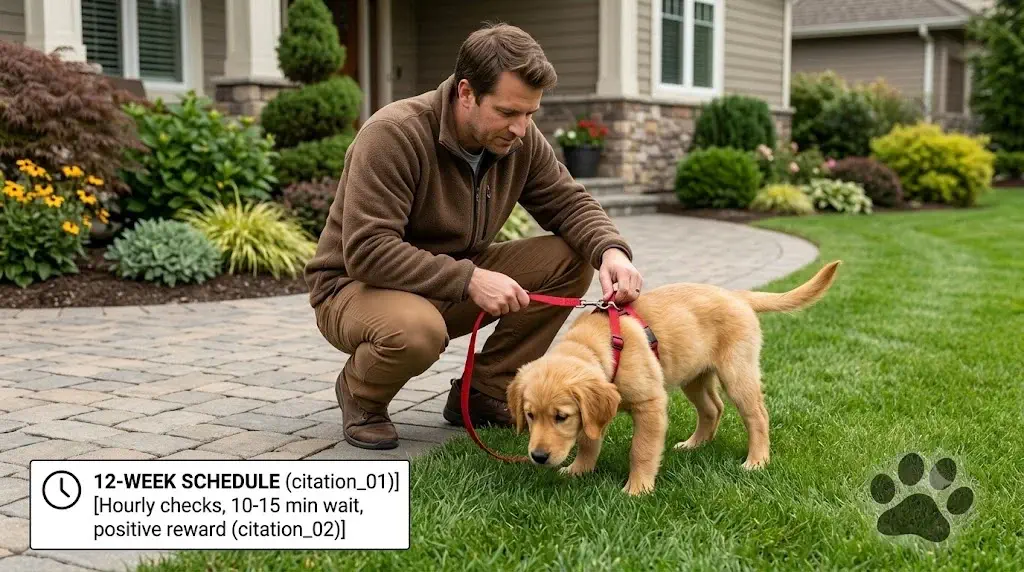
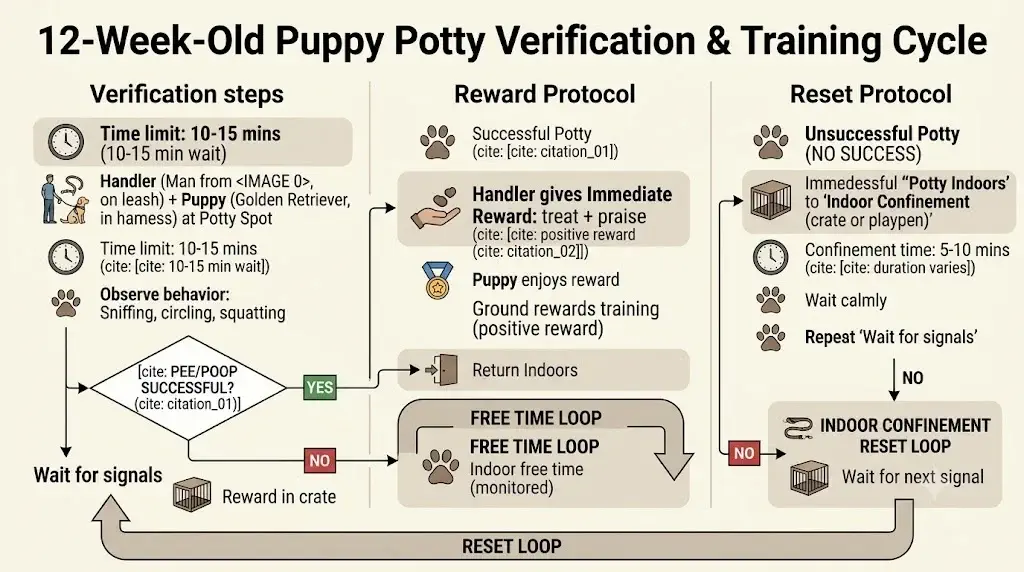
What Do You Do When Your Puppy Goes Outside but Does Not Potty?
Structured crate confinement resets prevent un-voided urine from being deposited on home flooring. If your 12-week-old puppy spends five minutes sniffing outdoors without voiding, do not grant unrestricted indoor freedom upon returning inside.
Escort the puppy indoors on-leash and place them directly into their crate or keep them tethered on a short lead[cite: 3]. Wait 10 to 15 minutes under quiet conditions, then walk them straight back outside for a focused three-minute retry[cite: 3]. Repeat this confinement loop until elimination occurs successfully on the turf[cite: 3].
How to Handle a Potty Accident at 12 Weeks
Calm interruption and immediate outdoor redirection preserve handler trust while correcting accidents. If you catch your puppy beginning to squat indoors, handle it methodically:
- Interrupt with a neutral verbal marker (such as “Outside”) without shouting or startling.
- Guide the puppy briskly by leash to activate their natural holding reflex.
- Escort them directly to the designated outdoor grass relief spot.
- Reward generously at grass level if they complete their elimination outside.
- Clean the indoor mess thoroughly with an enzymatic cleaner while the puppy is in another room.
- Log the accident timestamp and shorten your scheduled interval by 15 minutes.
Physical punishment or yelling does not teach a puppy where to go; it simply teaches them to hide their accidents behind furniture.
Why Enzymatic Cleaning Matters
Bio-enzymatic digesters break down insoluble uric acid crystals to eliminate persistent scent attractants. Standard household detergents, bleach, and ammonia-based cleaners mask odors to human noses but leave underlying pheromones that draw puppies back to re-soil the same area.
Blot fresh urine immediately with clean paper towels under firm downward pressure. Saturate the spot thoroughly with a CRI-certified bio-enzymatic cleaner to digest organic proteins, allowing it to dwell for 15 minutes before air drying. Thorough decontamination ensures that lingering scent markers do not compromise your training schedule.
12-Week-Old Puppy Bathroom Schedule for Apartment Living
Transit through multi-floor residential hallways introduces delay that requires proactive scheduling. Shared elevators, interior corridors, and security lobbies consume valuable minutes when bladder urgency is critical.
Stage your leash, shoes, and treats directly beside the door. Walk your 12-week-old puppy briskly on a short lead (or carry if elevators are slow) directly to the street-level relief area. For high-rise apartments with substantial elevator transit times, a real-grass balcony box offers an effective intermediate solution that reinforces natural turf preferences.
12-Week-Old Puppy Bathroom Schedule for Working Owners
Extended workday absences require arranged caregiver visits or an enclosed playpen arrangement. A 12-week-old puppy cannot physically hold their bladder through an 8-to-10-hour workday without distress.
Should You Use Puppy Pads at 12 Weeks?
Absorbent fabric training pads often blur substrate preferences, delaying outdoor housebreaking reliability. The soft fabric texture of commercial pee pads closely mimics living room carpets, rugs, and bath mats under puppy paws.
If your ultimate goal is outdoor elimination, transition away from indoor pads by 12 weeks of age. If living in an urban high-rise requires indoor accommodations, utilize a real-grass delivery box rather than fabric pads to condition proper natural turf preferences from the beginning.
How to Track Your 12-Week-Old Puppy Bathroom Schedule
A written potty tracking log reveals individual elimination patterns that generic timetables miss. Maintain a simple notebook or smartphone log for seven days to spot your puppy’s unique metabolic rhythms:
| Timestamp | Preceding Routine Event | Elimination Outcome | Behavioral Notes |
|---|---|---|---|
| 6:30 AM | Woke from overnight crate | Urinated within 30s | Direct walk outside on leash; rewarded on grass. |
| 6:45 AM | Breakfast kibble consumed | No voiding | Tethered for 25-minute post-meal digestion window. |
| 7:15 AM | Post-breakfast outdoor trip | Defecated (firm stool) | Gastrocolic reflex kicked in at 30m. |
| 9:00 AM | Pre-nap outdoor break | Urinated | Settled calmly in crate for morning rest. |
| 11:00 AM | Woke from morning nap | Urinated | Immediate walk to turf; clean success. |
Reviewing this log clarifies whether your puppy needs 20 or 30 minutes to defecate after eating, or if active play requires a break sooner than the scheduled timer.
12-Week-Old Puppy Bathroom Schedule: A Practical Decision Tree
Clear behavioral branching rules guide consistent handling during daily domestic transitions. Use this diagnostic decision framework:
Puppy Just Awakened?
Yes → Move directly to the outdoor grass area within 60 seconds without indoor floor exploration.
Puppy Just Finished Eating?
Yes → Supervise closely on tether and provide an outdoor elimination trip 15 to 25 minutes post-bowl.
Concluded Active Play?
Yes → Provide an immediate outdoor potty break before transitioning to quiet resting or crate naps.
Displacement Sniffing or Circling?
Yes → Treat as an emergency break immediately; do not wait for the scheduled timer to sound.
Consistent 7-Day Dryness?
Yes → Extend daytime intervals cautiously by 15 minutes while maintaining all wake-up and post-meal trips.
Accidents Reappearing?
Yes → Shorten scheduled intervals by 20 minutes and reduce unsupervised room freedom immediately.
When a Potty Problem May Need Veterinary Attention
Sudden urinary frequency changes accompanied by physical distress indicate underlying clinical disease. Not all housebreaking breakdowns stem from management or schedule gaps.
Contact your veterinarian promptly if you observe any of these warning signs:
- Straining with only tiny droplets produced, or crying during urination.
- Cloudy, blood-tinged, or foul-smelling urine indicating potential cystitis.
- A sudden surge in accidents after weeks of clean domestic habits.
- Excessive, unquenchable water consumption during daytime or evening hours.
- Involuntary urine dribbling while asleep in the crate.
12-Week-Old Puppy Bathroom Schedule Checklist
Standardized operational routines establish household cleanliness and prevent regressions across daytime and nighttime hours. Follow this complete procedural checklist:
- Take the puppy outside immediately upon waking from every sleep or nap.
- Schedule a focused outdoor break 15 to 25 minutes after every meal.
- Interrupt active play sessions every 30 to 40 minutes for a quick potty trip.
- Provide an elimination break before placing the puppy into a crate or playpen.
- Offer a verified final bathroom opportunity immediately before bedtime[cite: 1, 2].
- Watch for subtle pre-potty cues: sniffing, circling, pacing, and sudden restlessness.
- Respond to individual behavioral signals instead of relying exclusively on the clock.
- Deliver pea-sized high-value treats at ground level within three seconds of voiding.
- Maintain the exact same designated outdoor relief spot on every trip.
- Keep fresh water appropriately accessible throughout active daytime hours.
- Log daily accidents and successes to identify your puppy’s unique metabolic rhythms.
- Extend schedule intervals only after seven consecutive accident-free days.
- Reduce indoor freedom immediately if accidents increase.
- Clean accident areas thoroughly with a certified bio-enzymatic cleaner.
- Never punish, scold, or startle a puppy for housebreaking accidents.
- Consult a veterinarian if urination becomes painful, unusually frequent, or bloody.
Frequently Asked Questions
How often should a 12-week-old puppy go potty?
A 12-week-old puppy needs bathroom opportunities every 90 minutes to 2 hours while awake, immediately upon waking from naps, 15 to 25 minutes after meals, after active play, and right before bedtime. The exact interval varies by puppy and should be adjusted based on recorded successes and accidents.
What is a good 12-week-old puppy potty schedule?
A practical schedule pairs 90-minute daytime awake intervals with biological event triggers—immediate trips after waking, post-meal breaks, play interruptions, and structured crate naps—along with a final pre-bed elimination trip at 10:30 PM.
Can a 12-week-old puppy hold its pee for 4 hours?
While a 12-week-old puppy may sleep in a crate for four hours without urinating, an active, awake puppy playing in your living room usually needs to eliminate every 90 minutes to 2 hours. Four hours should never be treated as a guaranteed holding limit during active daytime hours.
How long can a 12-week-old puppy hold its bladder?
There is no single universal maximum for every puppy. While asleep, a 12-week-old puppy can often hold for 5 to 6.5 hours; while awake and active, holding capacity is typically 1.5 to 2.5 hours.
Does a 12-week-old puppy need to pee at night?
Many 12-week-old puppies can sleep through the night (6 to 7 hours) without eliminating, while others still require a single overnight relief break around 3:30 AM. Base nighttime trips on your puppy’s individual pattern rather than forcing every pup onto the same schedule.
Should I wake my 12-week-old puppy to pee?
Not necessarily. If your puppy consistently sleeps through the night without accidents, there is no need to wake them. If they regularly have accidents in the crate before dawn, provide a responsive or scheduled 3:30 AM relief trip.
How soon after eating should a 12-week-old puppy go potty?
Take your puppy outside 15 to 25 minutes after finishing a meal to capture the gastrocolic reflex. Watch for floor sniffing or pacing, and escort them directly to their outdoor relief area.
Should I limit water to potty train my 12-week-old puppy?
No. Growing puppies require continuous access to fresh water throughout the day. Water should never be restricted to manage house training. You may lift the bulk water bowl two hours before bed, provided daytime hydration has been normal[cite: 1, 2].
Why is my 12-week-old puppy still having accidents?
Common causes include missed post-nap breaks, granting too much unsupervised freedom, or waiting for the puppy to signal at the door. Three-month-old puppies still require proactive management rather than passive observation.
Is it normal for a 12-week-old puppy to have accidents?
Yes. Housebreaking is an ongoing developmental learning process at twelve weeks of age. Bladder muscle control and communication skills are still developing; occasional accidents are completely normal.
When can a 12-week-old puppy have more freedom in the house?
Expand indoor freedom gradually only after the puppy goes several consecutive weeks without an accident while under supervision. Increase access one room at a time rather than opening up the entire house at once.
What should I do if my 12-week-old puppy refuses to potty outside?
Wait calmly on-leash for five minutes. If no voiding occurs, escort the puppy back inside, place them in their crate or on a short tether for 10 to 15 minutes, and re-attempt the outdoor break[cite: 3]. Avoid granting free indoor roaming after an unproductive trip[cite: 3].
The Bottom Line
A 12-week-old puppy bathroom schedule accommodates expanding physical holding capacity, but it must remain anchored to frequent opportunities and predictable triggers.
Escort your puppy outside immediately upon waking, 15 to 25 minutes post-feeding, after energetic play, and before every nap and overnight sleep[cite: 1, 2]. Watch closely for subtle pre-potty body language, and extend daytime intervals gradually only after documented strings of success. When accidents happen, treat them as useful data: adjust your schedule timing, tighten indoor supervision, and reward every outdoor success generously on the turf. With steady repetition, proactive management transforms developing bladder control into lifelong housebreaking reliability.
Editorial note: This article provides general puppy house-training information for U.S. households, aligned with American Kennel Club (AKC) behavioral principles and American Veterinary Medical Association (AVMA) pediatric care standards. Puppies differ in size, development, health, feeding schedules, sleep patterns, and elimination needs. Veterinary advice should take priority when urination or bowel habits change suddenly, persistently, or in a way that appears abnormal.
