
CRI & CONSUMER REPORTS STANDARDS 2026
Enzyme Cleaner vs Regular Pet Cleaner: Which Should You Use?
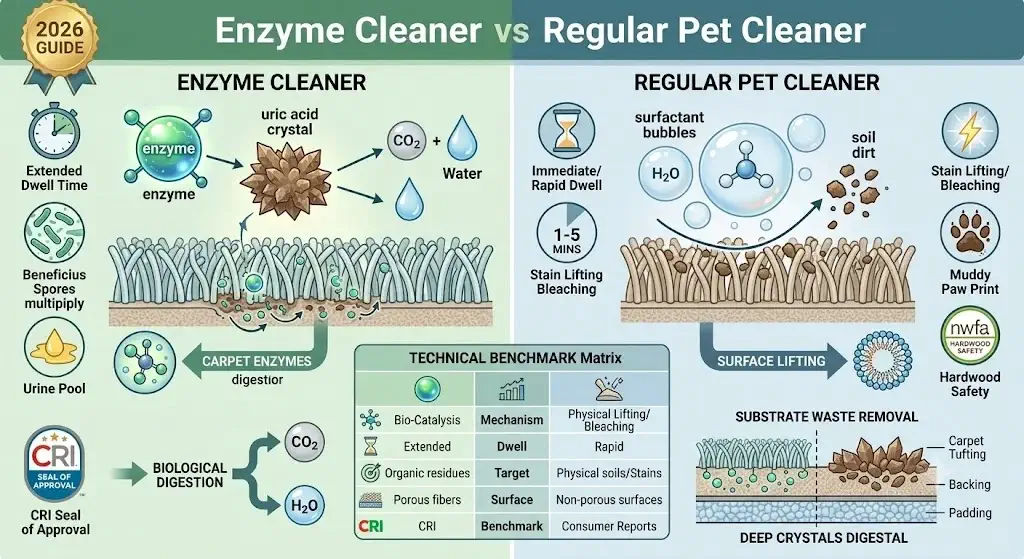
Enzyme cleaners deploy biological bacterial catalysts to consume organic uric acid crystals, whereas regular pet cleaners utilize surfactants and oxidizers to lift surface pigmentation and mask odors. In the debate between an enzyme cleaner vs regular pet cleaner, biological formulations are usually the better choice for puppy urine, feces, vomit, and other organic pet accidents when lingering odor is a concern. Regular pet cleaners can be a better fit for routine dirt, surface cleaning, fresh visible stains, or situations where you mainly need general cleaning rather than biological residue removal.
The important distinction is that “pet cleaner” describes a broad commercial product category, while “enzyme cleaner” describes a specific biochemical mechanism. Some general pet cleaners contain live bacterial cultures, some use oxidizing hydrogen peroxide chemistry, some rely primarily on ionic surfactants, and others focus strictly on fragrance-based odor masking. Understanding the functional differences between an enzyme cleaner vs regular pet cleaner prevents permanent damage to domestic textiles and delicate wood finishes.
The answer is not simply that biological enzyme formulas are universally superior for every household mess. Independent 2026 laboratory testing from Consumer Reports on pet stain-and-odor sprays confirms that cleaning chemistries yield contrasting performance profiles: non-enzymatic oxidizers frequently remove visual stains faster, while microbial enzymes excel at destroying gaseous ammonia sources at the molecular level.
Quick Reference Specification: Enzyme Cleaner vs Regular Pet Cleaner Matrix
This calibrated biochemical specification matrix benchmarks active molecular mechanisms, recommended dwell times, target contamination, and substrate compatibility across both product categories.
| Technical Metric | Enzyme Cleaner Formulation | Regular Pet Cleaner Formulation |
|---|---|---|
| Primary Active Chemistry | Dormant Bacillus spores + specific enzymes (protease, urease, lipase) | Anionic/non-ionic surfactants, hydrogen peroxide oxidizers, d-Limonene |
| Reaction Mechanism | Biological digestion of organic soils into carbon dioxide and water | Surface tension reduction, pigment bleaching, or volatile encapsulation |
| Required Dwell Time | Extended (10–15 minutes minimum; up to 12 hours under damp cloth) | Immediate to rapid (1–5 minutes before surface blotting) |
| Uric Acid Salt Neutralization | Complete bio-digestion (eliminates humidity-triggered odor return) | Surface rinse only (insoluble salt crystals remain trapped in substrate) |
| Substrate Preservation Safety | Neutral pH (6.5–7.5); safe for nylon and wool carpets under CRI guidelines | Variable pH (5.5–9.5); oxidizers risk color stripping on delicate fabrics |
| Primary Target Contaminants | Urine puddles, fecal residues, vomit bile, blood, and territorial marking | Muddy paw tracks, surface dust, grease, spilled puppy food, and ambient dander |
| Third-Party Testing Benchmark | Carpet and Rug Institute (CRI) Seal of Approval; Good Housekeeping Best Value | Consumer Reports Stain Removal Standard; NWFA Hardwood Safety Protocols |
Quick Answer: Enzyme Cleaner vs Regular Pet Cleaner
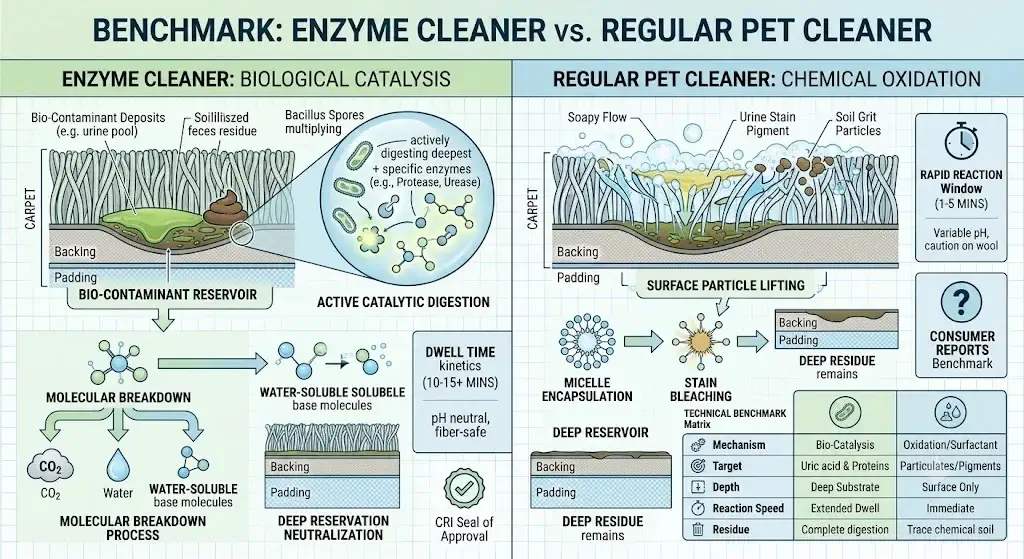
Enzyme cleaners destroy biological residues through catalytic metabolism, whereas regular pet cleaners rely on mechanical agitation and chemical oxidation to lift surface soils. When choosing between an enzyme cleaner vs regular pet cleaner, matching the formula to the precise contaminant ensures complete cleanup without damaging domestic floorings:
| Accident & Soil Factor | Enzyme Cleaner | Regular Pet Cleaner |
|---|---|---|
| Main Chemical Purpose | Digests organic compounds at molecular level | Lifts physical dirt, removes stains, or binds odors |
| Puppy Urine Puddles | Usually preferred (destroys uric crystals) | Depends on formula (risk of masking only) |
| Poop Accidents | Highly useful for residual enteric bacteria | Effective for surface smears and physical soils |
| Puppy Vomit & Bile | Highly useful for stomach acid proteins | Effective depending on surfactant concentration |
| Muddy Paws & Outdoor Grit | Usually unnecessary (lacks active enzymes for clay) | Usually preferred (rapid surfactant lifting) |
| Lingering Ammonia Malodor | Strongest choice (removes nitrogen source) | Temporary (relies on chemical encapsulators) |
| Reaction Speed & Dwell | Requires controlled dwell time (10–15+ mins) | Rapid flash evaporation or quick wipe |
| Routine Maintenance Care | Not optimal for daily dust or general mopping | Optimal choice for general household hygiene |
What Is an Enzyme Cleaner?
Enzyme cleaners utilize specialized biological catalysts and dormant bacterial cultures to disassemble complex organic proteins into inert base molecules. Pet accidents are particularly suitable for this biological mechanism because urine, feces, vomit, and other biological messes contain complex proteins and lipids that bond tightly to textile polymers and remain behind long after visible waste is wiped away.
Good Housekeeping explains that enzymes are selected because they physically digest the chemical components responsible for organic stains and volatile smells rather than temporarily masking odors with synthetic perfumes. Its 2026 testing established that enzyme cleaners are indispensable for biological pet waste, though individual products display significant differences in bacteria viability and active spore concentration.
How Enzyme Cleaners Work
Enzymes operate as biological lock-and-key catalysts. In pet accident cleanup, specific enzyme groups target particular organic compounds:
- Protease: Hydrolyzes peptide bonds in protein-based wastes, such as vomit, blood, and albumin residues.
- Urease: Dismantles urea and uric acid crystals, preventing nitrogen gas emissions.
- Lipase: Breaks down water-insoluble fats and lipids commonly found in fecal matter.
- Amylase: Catalyzes the breakdown of complex starches and carbohydrates from pet foods.
This biological specificity explains why the term enzyme should never be treated as a universal guarantee. Product performance depends on active spore count, formulation pH, ambient temperature, dwell time, and substrate moisture.
What Is a Regular Pet Cleaner?
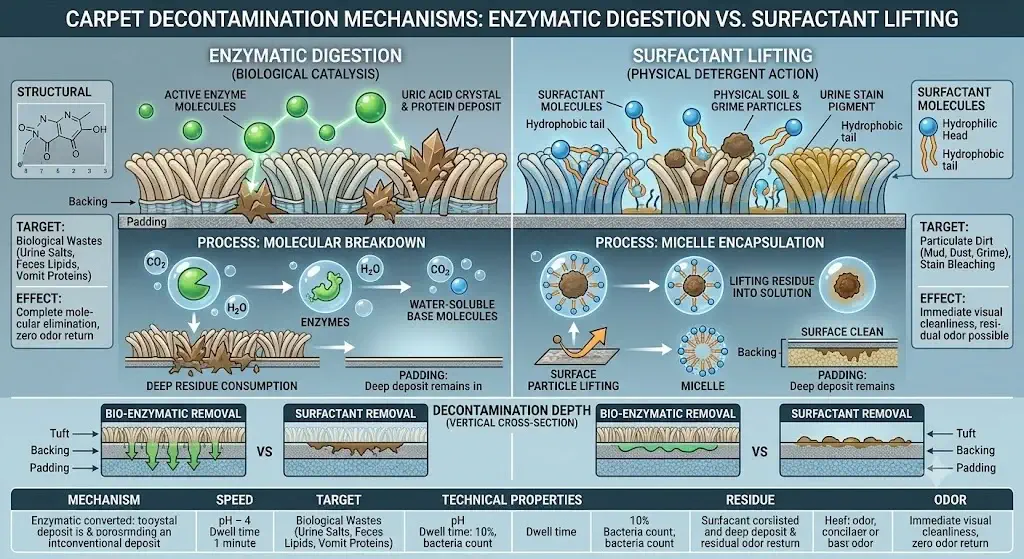
Regular pet cleaners employ synthetic surfactants, oxidizing compounds, and odor-encapsulating polymers to release surface dirt without biological incubation. Unlike clinical enzyme solutions, “regular pet cleaner” is a broad commercial umbrella encompassing multi-surface formulations engineered for rapid cleanup across home environments.
These commercial products achieve decontamination through diverse chemical methods:
- Surfactants (Ionic & Non-Ionic): Reduce water surface tension to penetrate dirt particles and lift physical debris into solution.
- Oxidizing Agents (Hydrogen Peroxide): Release oxygen micro-bubbles to chemically alter chromophores, bleaching organic stains visibly.
- Odor Encapsulators (Zinc Ricinoleate): Chemically entrap airborne volatile sulfur and nitrogen molecules upon contact.
- Plant-Derived Solvents (d-Limonene): Dissolve greasy residues and provide natural citrus scent without toxic fumes.
Some conventional pet cleaners include trace enzymes alongside harsh solvents, but their high-pH formulas often deactivate biological spores. Verifying exact ingredient lists on the back label is essential to distinguish true bio-catalysts from standard cleaning detergents.
Enzyme Cleaner vs Regular Pet Cleaner: The Biggest Difference
The fundamental divergence between these formulations lies in whether organic soils are biologically consumed or merely lifted and cosmetically masked. When comparing an enzyme cleaner vs regular pet cleaner, their underlying chemistry determines how they address the two distinct phases of pet accidents:
- Visible Contamination: The visible pigmentation, bile dyes, and particulate matter that discolors fibers and planks.
- Invisible Contamination: Microscopic uric acid crystals, lipids, and pheromones trapped beneath the surface layer that continually off-gas ammonia.
A standard surfactant cleaner can make carpet pile appear pristine while leaving hundreds of milligrams of insoluble uric acid crystals untouched in the backing. When seasonal humidity rises, those untreated salts rehydrate and emit renewed odors. Bio-enzymatic cleaners neutralize both visible pigmentation and invisible crystal reservoirs by digesting the organic contamination down to its molecular baseline.
When Should You Use an Enzyme Cleaner?
Enzymatic cleaners provide superior decontamination when pet accidents involve biological wastes whose microscopic residues trigger repeat territorial marking. In evaluating an enzyme cleaner vs regular pet cleaner, deploy biological enzymes across these four critical scenarios:
1. Puppy Urine Accidents
Urine represents the ultimate benchmark for biological formulas. Mammalian urine dries into insoluble uric acid salts that resist ordinary detergents. If eliminating pungent ammonia and preventing repeat accidents is your goal, choosing an enzyme-based formula is essential. To compare top-performing laboratory formulations, review our comprehensive Best Enzyme Cleaners for Puppy Urine guide.
2. Puppy Feces Residues
Solid feces contain dense protein matrices, bile pigments, and pathogenic enteric bacteria. After lifting bulk solids, applying an enzymatic cleaner allows proteases and lipases to digest the remaining film, sanitizing porous carpet tufts without abrasive scrubbing.
3. Puppy Vomit and Stomach Bile
Canine vomit presents a destructive combination of gastric hydrochloric acid, bile chromophores, and partially digested food proteins. Protease-rich enzyme cleaners neutralize these organic bonds before acidic bile permanently sets yellow stains into synthetic carpet fibers.
4. Repeated Elimination Locations
Puppies rely on sensitive olfactory receptors to identify previous potty zones. Standard household cleaners leave behind territorial pheromones that encourage indoor relapses. Bio-enzymatic digestion completely removes these microscopic scent triggers, reinforcing healthy crate and housebreaking habits.
When Should You Use a Regular Pet Cleaner?
Regular pet cleaners deliver rapid, cost-effective surface soil removal when domestic messes contain zero uric acid salts or biological proteins. When deciding between an enzyme cleaner vs regular pet cleaner, select conventional surfactant or oxidizing formulas under these conditions:
1. Muddy Paw Prints and Outdoor Soil
Outdoor mud consists of silica, clay minerals, and decomposed vegetable matter. Live bacterial enzymes have no catalytic effect on inorganic silt. A surfactant-based pet cleaner easily breaks surface tension, lifting mud off flooring without requiring extended dwell time.
2. Routine Hard-Floor Dust and Paw Grime
Daily tracking across tile, laminate, or finished hardwood calls for neutral-pH detergent maintenance. Standard pet-safe hard-surface cleaners lift surface dirt and evaporate quickly without leaving biological sticky films.
3. Fresh Non-Protein Stains
Spilled commercial dog kibble broth or dropped treats respond rapidly to standard oxidizing spot removers. If the stain does not originate from internal bodily fluids, heavy-duty surfactants remove visual pigmentation in minutes.
4. General Ambient Dog Odor
Wet canine fur, bedding grease, and everyday room odors stem from ambient dander and sebum rather than concentrated uric acid. Molecular odor-neutralizing sprays (such as zinc-complex encapsulators) clear room air far more efficiently than pouring enzyme solutions over dry furniture.
Are Enzyme Cleaners Better Than Regular Pet Cleaners?
Enzyme cleaners outperform regular cleaners specifically on organic nitrogenous wastes but show limited efficacy against non-biological inorganic soils. Neither cleaning chemistry is universally superior across all household maintenance situations.
For puppy pee, vomit, and organic stains, enzyme formulas are biochemically unmatched. However, for everyday track-in mud, dried dirt, or routine maintenance, conventional cleaners are faster, simpler, and more economical per square foot. Consumer Reports’ 2026 laboratory trials confirmed that several high-performing oxidizing sprays neutralized specific dog-urine stains faster than slow-acting bio-enzymes, proving that shoppers must select chemicals based on the exact mess rather than relying on promotional marketing labels alone.
Enzyme Cleaners vs Oxidizing Cleaners
Oxidizing cleaners alter stain chromophores through rapid chemical oxidation, while enzymatic cleaners digest organic substrates through sustained catalytic hydrolysis. Evaluating this distinction is crucial when comparing an enzyme cleaner vs regular pet cleaner powered by oxygen:
| Technical Characteristic | Enzyme-Based Cleaners | Oxidizing Cleaners (Oxy-Power) |
|---|---|---|
| Primary Chemical Action | Consumes biological proteins and uric acid salts | Releases free radicals to chemically bleach pigments |
| Speed of Visual Stain Lifting | Moderate (requires prolonged enzymatic dwell) | Rapid (bleaches color compounds in minutes) |
| Odor Source Remediation | Permanent (destroys the underlying food source) | Variable (oxidizes volatiles but may miss salt cores) |
| Substrate Colorfastness Safety | High safety across wool, nylon, and poly fibers | Moderate risk; can bleach organic wool or silk dyes |
| Active Working Window | Continues working as long as moisture is present | Ceases working once oxygen gas fully dissipates |
Consumer Reports testing emphasizes that while oxidizers lift visual stains with exceptional speed, biological enzymes remain the gold standard for long-term malodor elimination in thick carpet padding.
Why Contact Time Matters With Enzyme Cleaners
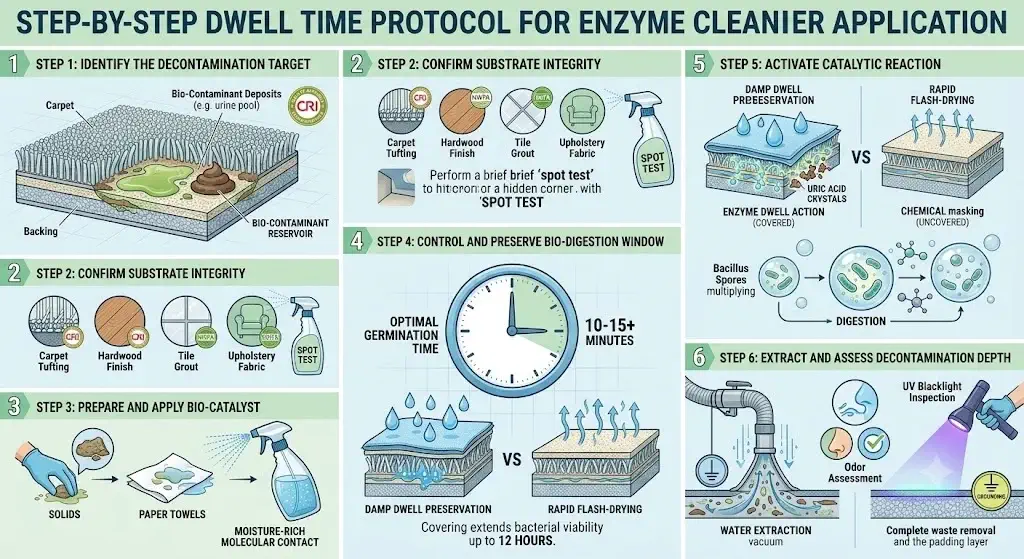
Enzymatic bio-catalysts require sustained liquid moisture to metabolize microscopic waste proteins into harmless gases. Spraying an enzyme cleaner and immediately wiping it away terminates the biological reaction before dormant spores can germinate.
Good Housekeeping’s 2026 pet testing illustrates this timing disparity: rapid-acting formulas like Rocco & Roxie show visible surface improvement within 15 minutes, whereas deep-set urine treatments (such as specialized Bissell formulas) may require 8 to 12 hours of covered damp dwell to digest uric crystals inside carpet backing. Always consult product labeling and maintain surface dampness with a clean microfiber cloth during active remediation.
Which Cleaner Is Better Across Specific Surfaces?
Substrate porosity and chemical resistance dictate whether biological enzyme soaking or rapid flash-drying detergents are safe to deploy. Evaluate how an enzyme cleaner vs regular pet cleaner performs across primary domestic floorings:
For Wall-to-Wall Carpets and Rugs
Enzyme cleaners are the primary choice for carpets. Textile fibers allow liquids to cascade through backing into open-cell padding, where only live biological bacteria can follow the path of contamination. For severe multi-spot room contamination, consider combining spot sprays with equipment from our Best Carpet Cleaners for Dog Urine guide.
For Finished Hardwood and Laminate
Surface compatibility takes precedence over enzyme labels. Applying heavy moisture-based enzyme sprays along plank seams can cause permanent edge cupping, crowning, and clear-coat delamination. Use only chemistry explicitly verified for wood finishes, as outlined in our authoritative Best Hardwood Floor Cleaners for Pet Urine analysis.
For Tile, Grout, and Luxury Vinyl
While glazed ceramic and luxury vinyl plank (LVP) are impermeable, unsealed cementitious grout lines are highly porous. Enzyme cleaners excel at penetrating cement grout pores to digest absorbed urine, whereas standard surface cleaners simply clean the tile surface.
Can You Use Both Cleaners Together?
Chemical interaction risks deactivating beneficial bacterial enzymes when conventional detergents and bio-cleaners are mixed indiscriminately. Applying harsh chemical solvents, bleach, or quaternary disinfectants immediately before or after an enzyme treatment kills live bacteria cultures instantly, neutralizing their digestive capacity.
The superior protocol is sequential and targeted:
- For Biological Waste: Apply the bio-enzymatic cleaner first, allow full dwell time, and blot dry.
- For Remaining Surface Soil: Once dry, apply a mild surfactant cleaner if physical mud or debris remains.
- For Broad Decontamination: Review our comprehensive Best Puppy Accident Cleaners benchmark for compatible multi-surface formulas.
How to Choose Between Them: Practical Decision Tree
Systematic assessment of accident chronicity and odor intensity reveals whether biological digestion or mechanical detergent lifting is warranted. Use this diagnostic decision guide:
Choose an Enzyme Cleaner If:
- The mess involves canine urine, liquid feces, vomit, or blood.
- Pungent ammonia odors persist after the puddle has dried.
- The puppy repeatedly marks the same corner or rug fringe.
- Contamination has penetrated porous carpet tufts, padding, or grout.
- You require Carpet and Rug Institute (CRI) certified colorfast biological removal.
Choose a Regular Pet Cleaner If:
- The mess is inorganic dirt, mud tracks, or outdoor sandbox sand.
- You need rapid, streak-free cleaning on finished wood, vinyl, or laminate.
- The accident is a non-protein food spill or dropped vegetable treat.
- You require immediate flash-drying without prolonged wet dwell times.
- The goal is light routine hygiene rather than biological source removal.
How to Use an Enzyme Cleaner Correctly
Methodical multi-stage application ensures active bacterial cultures achieve direct physical contact with embedded organic contaminants. Follow this 8-step decontamination protocol:
- Remove excess physical waste: Blot liquid puddles with paper towels or lift solids with cardboard scrapers. Avoid scrubbing.
- Verify substrate integrity: Confirm whether the surface is colorfast carpet, sealed hard flooring, or washable textile.
- Conduct a hidden spot test: Test cleaner compatibility on an inconspicuous fiber corner to verify dye stability.
- Apply cleaner generously: Spray enough formula to match the original urine puddle volume, penetrating carpet backing.
- Maintain adequate dwell contact: Allow solution to remain wet for 10 to 15 minutes (or cover with a damp towel for set-in odors).
- Blot with clean microfiber: Press clean white towels firmly over the treated site to extract dissolved soils.
- Allow complete natural air-drying: Maintain ambient airflow. Bacteria continue consuming waste until moisture fully evaporates.
- Inspect under UV blacklight: Re-examine the area in darkness to ensure uric crystal fluorescence is eradicated.
The American Kennel Club (AKC) specifically advises avoiding steam cleaners on pet urine, as high thermal heat binds protein molecules permanently to synthetic fibers.
Common Mistakes When Choosing Pet Cleaners
Misunderstanding product chemistry results in damaged home flooring finishes and persistent domestic malodors. Avoid these seven frequent user errors:
Assuming Every Pet Cleaner Contains Enzymes
The label “pet cleaner” does not denote enzymatic content. Many commercial sprays are merely perfumed detergents.
Wiping Enzyme Solutions Away Immediately
Bio-enzymes are living catalysts that require liquid dwell time to metabolize proteins. Quick wiping terminates their action.
Flooding Hardwood Seams With Enzyme Liquids
Wood absorbs liquid rapidly. Soaking hardwood seams causes black alkaline burns and board warping.
Deploying Vinegar or Household Ammonia
Consumer Reports explicitly warns against ammonia-based home remedies because ammonia mimics urine volatiles, drawing puppies back to re-mark.
Using Steam Mops on Biological Accidents
Thermal heat cooks urine proteins into carpet polymers. Always use ambient-temperature water during biological extraction.
Does an Enzyme Cleaner Prevent a Puppy From Peeing in the Same Spot?
Eliminating scent markers removes territorial triggers, but reliable elimination habits require structured housebreaking protocols. While bio-enzymatic digestion destroys internal pheromone cues, successful puppy development hinges on management:
| Operational Phase | Target Objective | Primary Tool |
|---|---|---|
| Substrate Decontamination | Destroy urine salts and territorial pheromones | Bio-enzymatic urine digester spray |
| Subfloor Moisture Barrier | Prevent liquid penetration during apartment training | Leakproof liners from our Best Puppy Pads for Apartments guide |
| Behavioral Reinforcement | Reward outdoor elimination within 3 seconds | High-value treats and structured crate scheduling |
Frequently Asked Questions (FAQ)
Is an enzyme cleaner better than a regular pet cleaner?
What is the main advantage of an enzyme cleaner?
Should I use an enzyme cleaner for puppy pee?
Do enzyme cleaners remove puppy poop stains?
Do enzyme cleaners work on puppy vomit?
Why do enzyme cleaners take longer to work?
Can I use an enzyme cleaner on hardwood floors?
Can I use a regular pet cleaner on puppy urine?
Do enzyme cleaners eliminate urine odor permanently?
Can I mix an enzyme cleaner with another pet cleaner?
Should I use an enzyme cleaner for muddy paws?
Is an enzyme cleaner the same as an odor eliminator?
What should I do if puppy urine still smells after cleaning?
Bottom Line: Match the Cleaner to the Chemistry of the Mess
Bio-enzymatic cleaners are essential for biological pet accidents, whereas conventional pet cleaners provide rapid maintenance for physical soils and surface stains. Choosing between an enzyme cleaner vs regular pet cleaner requires recognizing the chemical nature of the contaminant.
For puppy urine puddles, dried yellowing, fecal smears, and territorial marking, choose a certified bio-enzymatic formula and respect its required 10-to-15-minute dwell time. For muddy paw prints, routine hardwood dusting, and fresh non-biological food spills, rely on neutral-pH surfactant cleaners for rapid, residue-free results.
Remember the golden rule of pet decontamination: organic waste requires biological digestion, inorganic dirt requires surfactant lifting, and deep padding saturation requires motorized extraction. Deploying the correct chemical formulation preserves household flooring investments and accelerates successful puppy housebreaking.
